FreeCell Solitaire Strategy Guide
FreeCell is a one-player card game where almost every deal can be won by skill alone. All 52 cards start face-up; four free cells let you move single cards out of the way while you plan. This guide covers the rules, the supermove math that makes long sequences possible, six concrete strategies, the standard scoring system, and the unusual history of game #11982 — the one Microsoft FreeCell deal that nobody can solve.
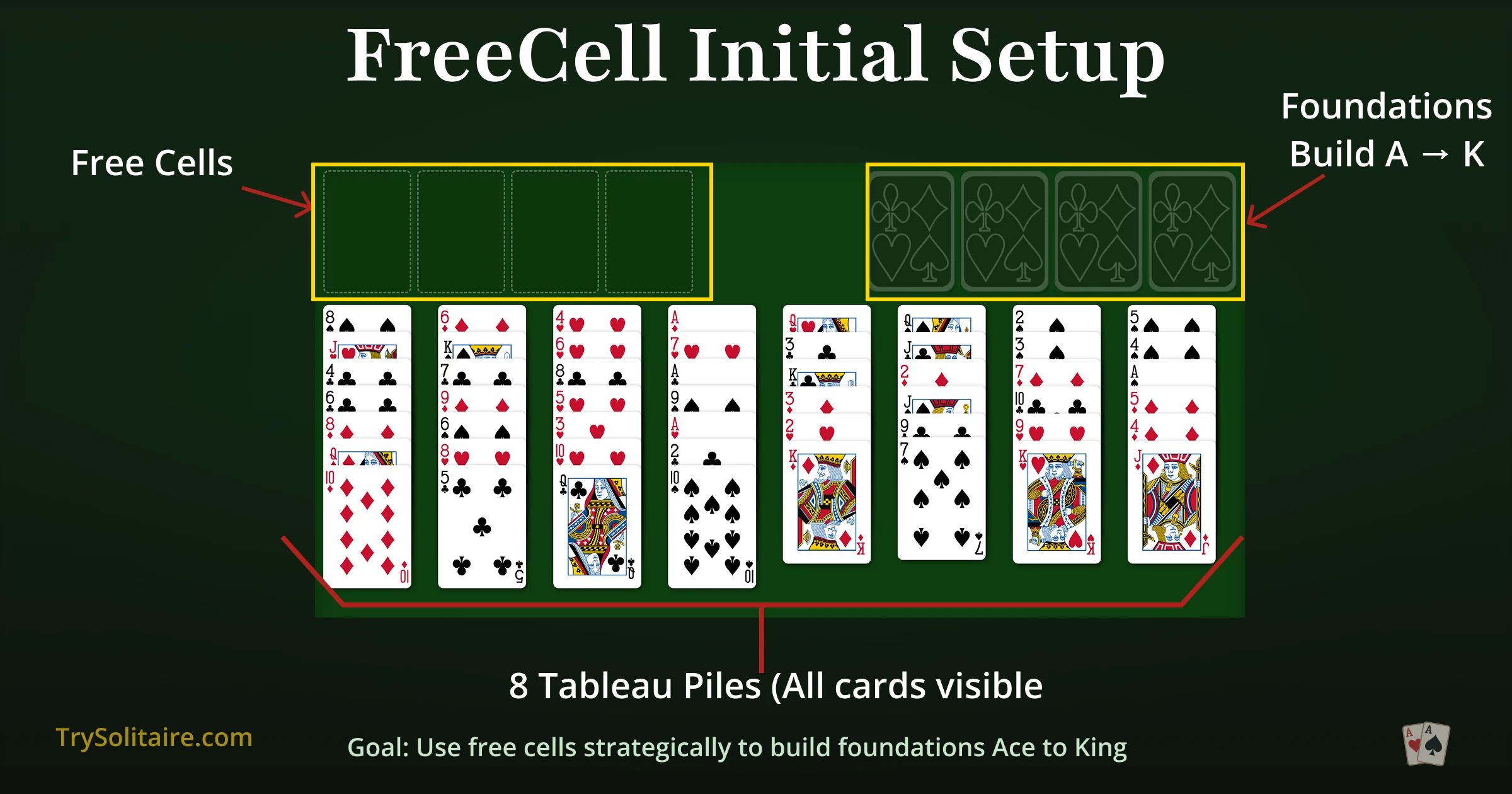
Table of Contents
What Is FreeCell?
FreeCell is a one-player card game played with a standard 52-card deck. The goal is to move every card to four foundation piles, building each suit from Ace up to King. Two design choices set FreeCell apart from most other solitaire variants. First, every card is dealt face-up, so there are no surprises hidden under the deal. Second, four "free cells" sit above the tableau and each holds one card you can park while you plan a sequence.
Together those choices turn solitaire into a puzzle of skill more than luck. Studies have shown that more than 99.99% of randomly generated FreeCell deals can be won with perfect play. Klondike, by comparison, leaves about 17 to 21% of deals unwinnable from the moment they are dealt.
The Layout
The FreeCell board has three areas:
- Tableau: eight columns of cards. The first four columns hold seven cards each; the last four hold six. All 52 cards are face-up.
- Free cells: four empty spaces in the top-left corner. Each holds a single card.
- Foundations: four empty spaces in the top-right corner. One per suit, built up from Ace to King.
You win the game when all four foundations are complete with 13 cards each.
The Rules
Tableau moves
Build tableau columns down by alternating colors. A black 7 goes on a red 8. A red 6 goes on a black 7. The strict rule is that you move one card at a time, but most digital versions (including ours) handle multi-card moves automatically when there is room — see the supermove section below.
Free cells
You can move any single card to any empty free cell. A card sitting in a free cell can be played onto a tableau column or a foundation when its turn comes. Treat free cells as short-term parking, not long-term storage.
Empty columns
Any card or properly ordered sequence can fill an empty tableau column. Unlike Klondike, you do not have to wait for a King.
Foundations
Foundations build up by suit, Ace to King. You can move a card from foundation back to tableau if you need to, but most digital versions discourage this with a small score penalty.
Supermoves: How Many Cards Can You Move?
FreeCell's strict rule is that you move one card at a time. But if you have empty free cells and empty columns, you could move a sequence of cards by hand — one card at a time, parking each in a free cell or empty column — and reach the same end state. Most digital versions just do this for you in one move and call it a "supermove".
The number of cards you can move in a single supermove is given by a simple formula:
(1 + empty free cells) × 2(empty columns)
| Empty free cells | Empty columns | Cards you can move |
|---|---|---|
| 0 | 0 | 1 |
| 1 | 0 | 2 |
| 2 | 0 | 3 |
| 3 | 0 | 4 |
| 4 | 0 | 5 |
| 4 | 1 | 10 |
| 4 | 2 | 20 |
| 4 | 3 | 40 |
The most important takeaway from the table: each empty column doubles your moving power, but each free cell only adds one card. An empty column is worth roughly four times an empty free cell when free cells are full.
This is why opening up an empty tableau column is one of the strongest moves in FreeCell.
Six Strategies That Actually Work
1. Move Aces and 2s to the foundations early
Aces and 2s have the lowest tableau value. They almost always free up cards above them and they can never block a useful move once they are on a foundation. Send them up as soon as they are exposed.
2. Empty a column whenever you can
An empty column doubles your supermove power (see the table above). Two empty columns quadruple it. This is the single most powerful tool in FreeCell — guard empty columns the way you would guard a King in Klondike.
3. Do not fill all four free cells
The moment all four free cells are occupied, your supermove count drops to one card. You also lose flexibility for emergencies. Try to keep at least one free cell open at all times. If you have to use the fourth, plan how it will be cleared in your next two moves.
4. Build long alternating runs in one column
A long red-black-red-black sequence concentrated in one column unblocks the cards underneath everything else. A column ordered K♥ Q♠ J♥ 10♠ 9♥ 8♠ ... is six cards of progress every time you move the King.
5. Look at the whole board before your first move
All 52 cards are visible. Take 30 seconds at the start of every game to find the cards blocking each Ace, and to plan three or four moves before you make the first one. FreeCell rewards thinking, not speed.
6. Do not rush to the foundation past the 5s
A 4 sent to a foundation can no longer cover a 5. A 5 sent to a foundation can no longer cover a 6. Cards in the middle ranks (4 through 9) are often more useful in the tableau than on the foundation. A common rule: keep the foundation no more than two ranks behind the lowest active card of the opposite color.
How Scoring Works
Our FreeCell uses the standard scoring formula from the original Microsoft Windows version. Four point sources combine for your final score:
| Source | Points | When |
|---|---|---|
| Foundation move | +10 | Per card sent to a foundation |
| Win bonus | +1,000 | When all four foundations are complete |
| Move efficiency | +100 | If the game is won in under 100 moves |
| Time bonus | +2 per second | For each second under 5 minutes (300 s) |
The 52 foundation moves alone are worth 520 points. A typical efficient win — 85 moves in 4 minutes — scores 520 + 1,000 + 100 + 120 = 1,740 points. A near-perfect speed run scores around 2,100. Top scores are saved locally so you can compare against your own past games.
A Short History
Paul Alfille created FreeCell in 1978 on the PLATO computer system at the University of Illinois, while a medical student. The PLATO version was written in TUTOR, the educational programming language designed for the system, and ran on PLATO terminals across universities and research institutions for years before reaching the home computer market.
Jim Horne, who first played the game on PLATO at the University of Alberta, ported FreeCell to MS-DOS in 1988 with color graphics. He joined Microsoft soon after, and his Windows port shipped first in Microsoft Entertainment Pack Volume 2, then in the Best of Microsoft Entertainment Pack, and finally as a bundled game in Windows 95. Every Microsoft Windows release since has included it.
In 1994, Dave Ring organized the Internet FreeCell Project on Usenet — over 100 volunteers attempting to solve every one of the 32,000 numbered deals in the Microsoft version. By April 1995 they had solved all but one. That deal, #11982, is the subject of the next section.
Famous Game Numbers
The Microsoft Windows FreeCell ships with 32,000 numbered deals you can replay. Most are routine. A few are notable:
- Game #11982 — provably unsolvable. The Internet FreeCell Project tried this one first by hand and could not crack it. Multiple independent computer solvers have since exhaustively searched the move tree and confirmed: there is no winning sequence from this deal.
- Game #1941 — the practical hardest among solvable deals. Often listed in player communities as the hardest of the 32,000 deals that can be won. Players who clear it generally do so with sustained planning rather than raw speed.
- Game #617 — almost-too-easy. Sometimes used as a tutorial because every Ace is reachable on the first move and the path to victory is unusually short.
In 1994, Don Woods extended the analysis beyond the original 32,000. His program tried one million randomly generated deals and found only 14 unsolvable — a 99.9996% solvability rate. That study remains the most-cited source for FreeCell's "almost every deal is winnable" reputation.
FreeCell Variants
FreeCell is part of a small family of free-cell solitaire games. The main siblings worth knowing:
- Eight Off: uses eight free cells instead of four, and the tableau is dealt in eight columns of six cards. The extra free cells make Eight Off forgiving for beginners but reduce the strategic pressure that makes FreeCell interesting.
- Baker's Game: identical setup to FreeCell, but the tableau builds down by suit instead of alternating colors. Most published deals are unsolvable; the game is much harder than FreeCell.
- Forecell: the four free cells start filled with the first four cards of the deck. Slight twist on the opening, no significant change to mid-game play.
- Seahaven Towers: ten tableau columns of five cards each, four free cells, two extra cells reserved for Aces. Popular on classic Mac systems in the late 1980s.
If you finish FreeCell and want a stricter test, try Eight Off or any of the standard variants on this site.
Frequently Asked Questions
Are all FreeCell games winnable?
Almost. Don Woods' 1994 study analyzed one million randomly generated FreeCell deals and found only 14 unsolvable — a 99.9996% win rate with perfect play. Of the original 32,000 numbered Microsoft deals, exactly one (#11982) is provably unsolvable. If you lose, the deal is almost certainly not the reason.
What is the supermove formula in FreeCell?
The number of cards you can move at once equals (1 + empty free cells) × 2 raised to the empty-column count. With four free cells and one empty column, you can move 10 cards. Each empty tableau column doubles your moving power, which is why empty columns matter more than free cells.
Who invented FreeCell?
Paul Alfille created FreeCell in 1978 on the PLATO computer system at the University of Illinois. Jim Horne, who first played it on PLATO, ported the game to MS-DOS in 1988 and later to Microsoft Windows. FreeCell shipped in Microsoft Entertainment Pack Volume 2 and has come with every Microsoft Windows release since 1995.
Why is game #11982 special?
Game #11982 is the single unsolvable deal in the original 32,000 numbered Microsoft FreeCell games. The Internet FreeCell Project, run by Dave Ring on Usenet in 1994, organized over 100 volunteers to attempt every deal. By April 1995 they had solved all 32,000 except #11982. Computer solvers have since confirmed it has no winning sequence of moves.
Why is FreeCell easier than Klondike?
Two reasons. Every card is face-up from the start, so there is no luck of the draw. The four free cells also let you set cards aside while you plan. Klondike hides about half the deck and gives you no temporary storage, so a bad shuffle can lose Klondike before you have seen the cards.
How does FreeCell scoring work?
Each card sent to a foundation is worth 10 points. Completing the game adds a 1,000-point win bonus. Finishing in under 100 moves adds another 100 points. Finishing in under five minutes adds 2 points per remaining second. A typical efficient win scores between 1,500 and 2,000 points.
Try It Yourself
The fastest way to internalize the supermove math and the strategy tips above is to play a few games with them in mind.
Play FreeCell Free