Free Solitaire Solver: Check If Your Klondike Game Is Winnable
About one in five Klondike deals is unwinnable from the moment the cards are dealt. Without a solver, you can spend ten minutes on a doomed game without knowing. Our solver runs in your browser, checks every position you reach, and tells you in real time whether the game still has a winning path. It also lets you start with a deal that has a verified solution and rewind to the last solvable state when you slip.
Play Solitaire with Built-in SolverTable of Contents
- What Is a Solitaire Solver?
- How to Use the Solver
- Solver-Powered Features
- How the Solver Works
- Solvability — The Real Numbers
- Built-in vs External Solvers
- FAQ
What Is a Solitaire Solver?
A solitaire solver is a program that searches the tree of legal Klondike moves. Starting from your current position, it tries one move, then another, and another — looking for a sequence that ends with all 52 cards on the foundations. Think of it as a chess engine for solitaire.
Most solvers are standalone tools. You enter your card layout by hand, wait, and read the answer. Ours is built into the game. It reads your position automatically, runs in the background, and updates the toolbar icon as you play. No setup, no copying card values, no breaking your flow.
- No manual entry. The solver reads the board for you.
- Live feedback. Check at any point during play.
- Deal Winnable. Start with a hand that has a known solution.
- Undo to Winnable. Rewind to the last solvable state when you slip.
- Free. No account, no usage cap.
- Private. Runs in your browser. No data leaves your device.
How to Use the Solver
The solver lives in the game toolbar. Each icon means something different.
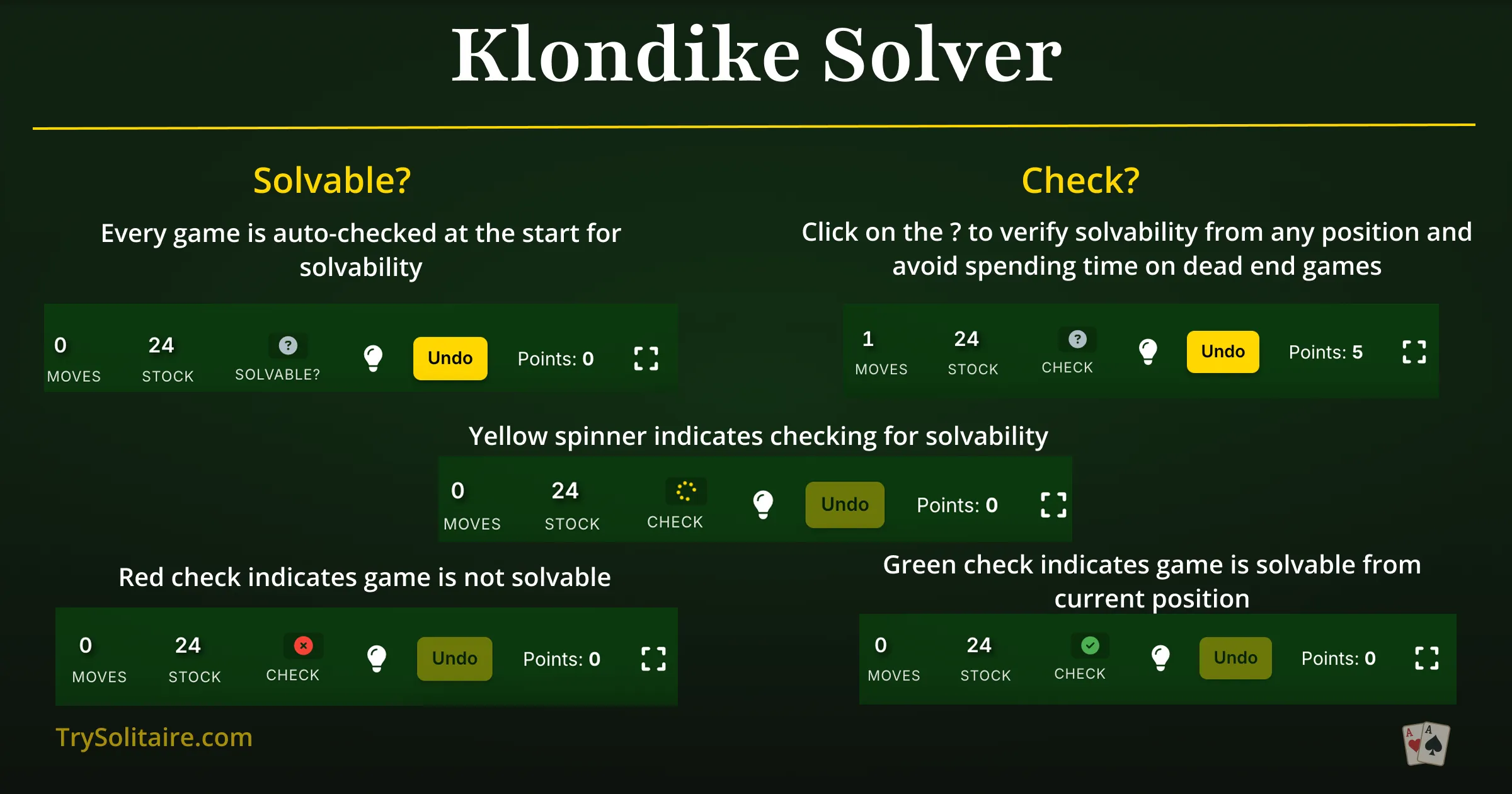
What each icon means
- Green checkmark — a winning path exists from this position. You may not see it yet, but it's there.
- Red X — no winning path exists. Click to open the recovery panel.
- Gold spinner — the solver is analyzing. Most checks finish in a few seconds.
- Gray question mark — not yet checked, or the search timed out. Click to run it.
Step-by-step
- Start a new game. The solver checks the deal in the background.
- Play normally. Make your moves the way you would in any Klondike game.
- Click the icon. A click triggers a fresh check at any point.
- Green? Keep going — a solution exists.
- Red? Open recovery. The fastest path is Undo to Winnable.
Solver-Powered Features
Deal Winnable
Choose Deal Winnable in the new-game menu. The solver picks a seed with a verified solution before any cards are dealt. You skip the unwinnable deals entirely. Available in Draw 1 and Draw 3.
When to use Deal Winnable
- Learning. Practice strategy without losing time on impossible deals.
- Short sessions. A coffee break shouldn't end on a deal that was already lost.
- Draw 3. Practical win rates here are 10–15% with skilled play. Starting solvable removes a major variable.
- Building a streak. Solvable deals reward improvement directly.
Undo to Winnable
When the solver detects no winning path remains, the recovery panel appears. The most useful option is Undo to Winnable — it rewinds to the last position with a solution. You don't lose your progress; you just back up a few moves and try a different line.
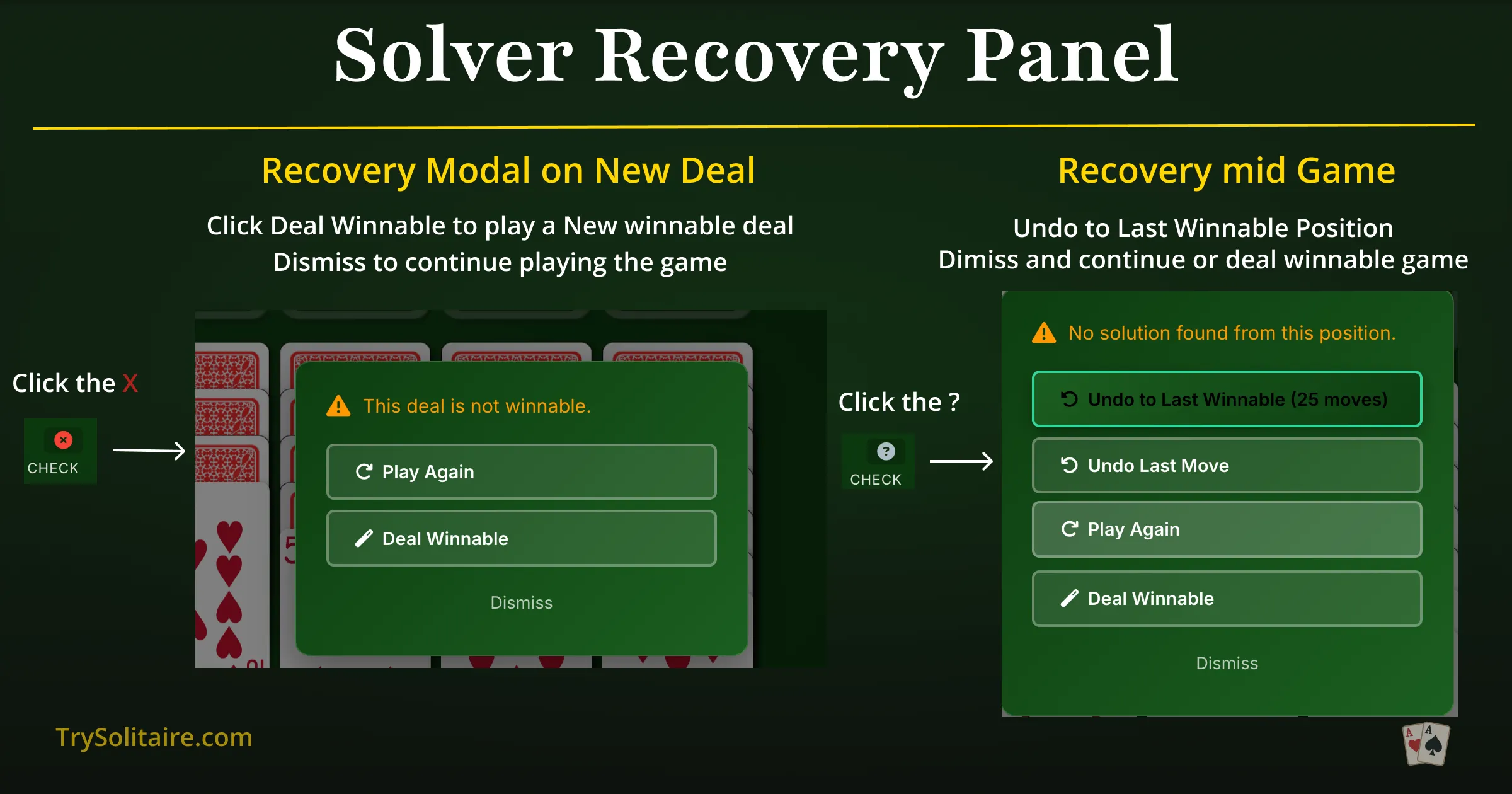
- Undo to Winnable. Rewinds to the last solvable position. Best option in most cases.
- Deal New Game. Start fresh with a new hand.
- Continue Playing. Stay in the current game even though it can't be won.
Background analysis on every new deal
The solver checks each new deal automatically. Within seconds you see whether the game has a solution — before your first move. Useful in Draw 3 especially, where practical win rates are low.
On-demand position check
Click the icon mid-game to check your current position. The solver looks at your exact state, not the original deal. It accounts for every move you've made.
How the Solver Works
For readers who want the details under the hood.
Algorithm
The solver runs a depth-first search with iterative deepening. From your current position it explores moves that look promising — usually those that uncover face-down cards or extend the foundations — and prunes branches that are demonstrably worse. Iterative deepening means it searches shallow first (150 moves), then deeper (250, 400, 600). Shorter solutions surface first.
Optimizations
Klondike has an astronomical state space, so brute force isn't viable. The solver uses several tricks:
- Forced foundation moves. Aces and 2s go up automatically. Sending them up is never a wrong move, so the solver doesn't branch on it.
- State deduplication. Visited positions are hashed and remembered. If a state is reached twice, the second time is skipped.
- Move ordering. Foundation plays first, then tableau-to-tableau, then stock draws. Solutions tend to fall out faster.
- Stock recycle limits. Two passes for Draw 3, three for Draw 1. Keeps the search space bounded.
Performance limits
- Evaluations. Up to 10 million per check.
- Time. 30-second cap per attempt.
- Background thread. Runs in a Web Worker. The game UI never freezes.
- Compact state. Cards are stored as integers (0–51), not objects. Memory stays small.
Privacy
The solver runs entirely in your browser. No API calls, no telemetry, no server. Your game state never leaves the device. Once the page has loaded, the page works offline.
Solvability — The Real Numbers
Klondike's winnability has been a research question since the 1990s, and the literature is messier than most casual sources suggest. Here are the numbers that hold up.
Theoretical winnability
The most-cited result is from Yan, Diaconis, Rusmevichientong and Van Roy (2005). Using a Markov-chain Monte Carlo approach, they estimated that about 82% of Klondike deals are solvable with perfect play. That figure applies to the deals themselves and is the same in Draw 1 and Draw 3 — the deck is the same; only access changes.
Practical winnability
What players actually achieve is much lower:
- Draw 1, skilled play: ~40% of games won.
- Draw 1, average player: 25–30%.
- Draw 3, skilled play: ~10–15%.
- Draw 3, average player: 5–10%.
The Draw 3 gap is access, not difficulty. The same deals are theoretically solvable; the stock-pile constraint just makes it harder to reach the moves you need.
Why the solver matters
About one in five deals is theoretically unwinnable in either mode. Without a solver you can't tell. With Deal Winnable on, every game starts solvable — your skill becomes the only variable. With Undo to Winnable, slipping into an unsolvable position is no longer terminal.
Where the wrong numbers come from
You'll see confident claims like "21% of Draw 1 deals are unwinnable, 70% of Draw 3 deals are unwinnable." Those numbers aren't from primary research. They appear to conflate theoretical solvability with practical win rates. The right framing is two facts: about 82% of deals are theoretically solvable in either mode, and skilled players win roughly half the deals their mode allows them to.
Built-in vs External Solvers
Most Klondike solvers online are standalone web pages or downloadable tools. Here's how the built-in solver compares.
| Feature | TrySolitaire (built-in) | External solver tools |
|---|---|---|
| Input method | Reads board automatically | Manual card entry |
| Real-time check | Yes, during play | No, separate tool |
| Deal Winnable | Yes | No |
| Undo to Winnable | Yes | No |
| Privacy | Client-side only | Often server-side |
| Cost | Free, no limits | Often capped or paid |
| Draw 3 support | Yes | Varies |
| Works offline | Yes | Rarely |
FAQ
What is a solitaire solver?
A solitaire solver searches the tree of legal Klondike moves to find a sequence that wins from your current position. TrySolitaire's solver runs in your browser and tells you whether such a sequence exists. It does not show the moves — only whether a path is there.
Is the solver free?
Yes. No account, no premium tier, no usage limits. Deal Winnable and Undo to Winnable are also free. The solver works offline once the page has loaded.
Does the solver tell me the moves?
No. It tells you whether a winning path exists, not what it is. That preserves the puzzle. For move ideas, use the separate Hint feature.
Does the solver work on mobile?
Yes. iPhone, iPad, Android phones, Android tablets, and desktop browsers all run the same Web Worker. Performance is consistent across devices.
Does it support Draw 3?
Yes. Both Draw 1 and Draw 3 are fully supported. Draw 3 is where the solver earns its keep — practical win rates are 10–15% even with skilled play.
How accurate is it?
When the icon is green, the solver has found a complete winning path. When it's red, the solver has exhausted the reachable states from your position and confirmed no path exists. Edge case: very tangled positions can hit the 10-million-evaluation or 30-second limit, which leaves the icon gray.
Is my game data sent to a server?
No. The solver runs in a Web Worker — a background thread inside your browser. Your moves, board state, and analysis results never leave your device.
Can I use the solver to cheat?
The solver tells you whether you can win, not how. Knowing a game is solvable doesn't make finding the solution any easier — there are still thousands of move combinations between you and the foundations. Most players use it to avoid spending time on doomed deals.
What makes this solver different?
External solvers are standalone tools that need manual card entry. This one is built into the game, automatically reads your board, runs in the background, offers Deal Winnable and Undo to Winnable, and stays client-side. No external tool offers all four together.
Try the Solver Now
Play Klondike with the built-in solver — free, no sign-up.
Play Solitaire with Solver✓ Built-in solver | ✓ Deal Winnable | ✓ Undo to Winnable | ✓ Free
Related
- Klondike Solitaire — rules, strategy, and the full Wes Cherry / Yan et al. story
- Is My Solitaire Game Winnable? — the difference between theoretical and practical solvability
- Klondike Strategy Guide — six concrete strategies that move the needle
- How to Win at Solitaire — patterns that work across the family
- Spider Solitaire Win Rates — how solvability changes with 1, 2, and 4 suits
References & Sources
- Yan, X., Diaconis, P., Rusmevichientong, P., & Van Roy, B. (2005). "Solitaire: Man Versus Machine." Advances in Neural Information Processing Systems 17, 1493–1500. The peer-reviewed Markov-chain Monte Carlo result establishing approximately 82% theoretical solvability for Klondike, applicable to both Draw 1 and Draw 3 (same deals, different access patterns).
- Bjarnason, R., Fern, A., & Tadepalli, P. (2009). "Lower Bounding Klondike Solitaire with Monte-Carlo Planning." Proceedings of the International Conference on Automated Planning and Scheduling (ICAPS) 19. Independent estimate consistent with Yan et al. and a foundation for modern Klondike solver design.
- The depth-first search with iterative deepening described on this page is a standard technique in game-tree search; see Russell, S. & Norvig, P. Artificial Intelligence: A Modern Approach (4th ed., 2020), Chapter 3.