Klondike Solitaire — Free Online with Solver
Klondike is the solitaire most people picture when they hear the word: seven tableau columns, a stock pile, four foundations from Ace to King. About one in five deals is unwinnable from the moment the cards are dealt. This version runs a solver in your browser that tells you whether your current position has a winning path, so you stop wasting time on impossible games. Draw 1 or Draw 3, unlimited undo, install-as-app for offline play. Free, no sign-up.
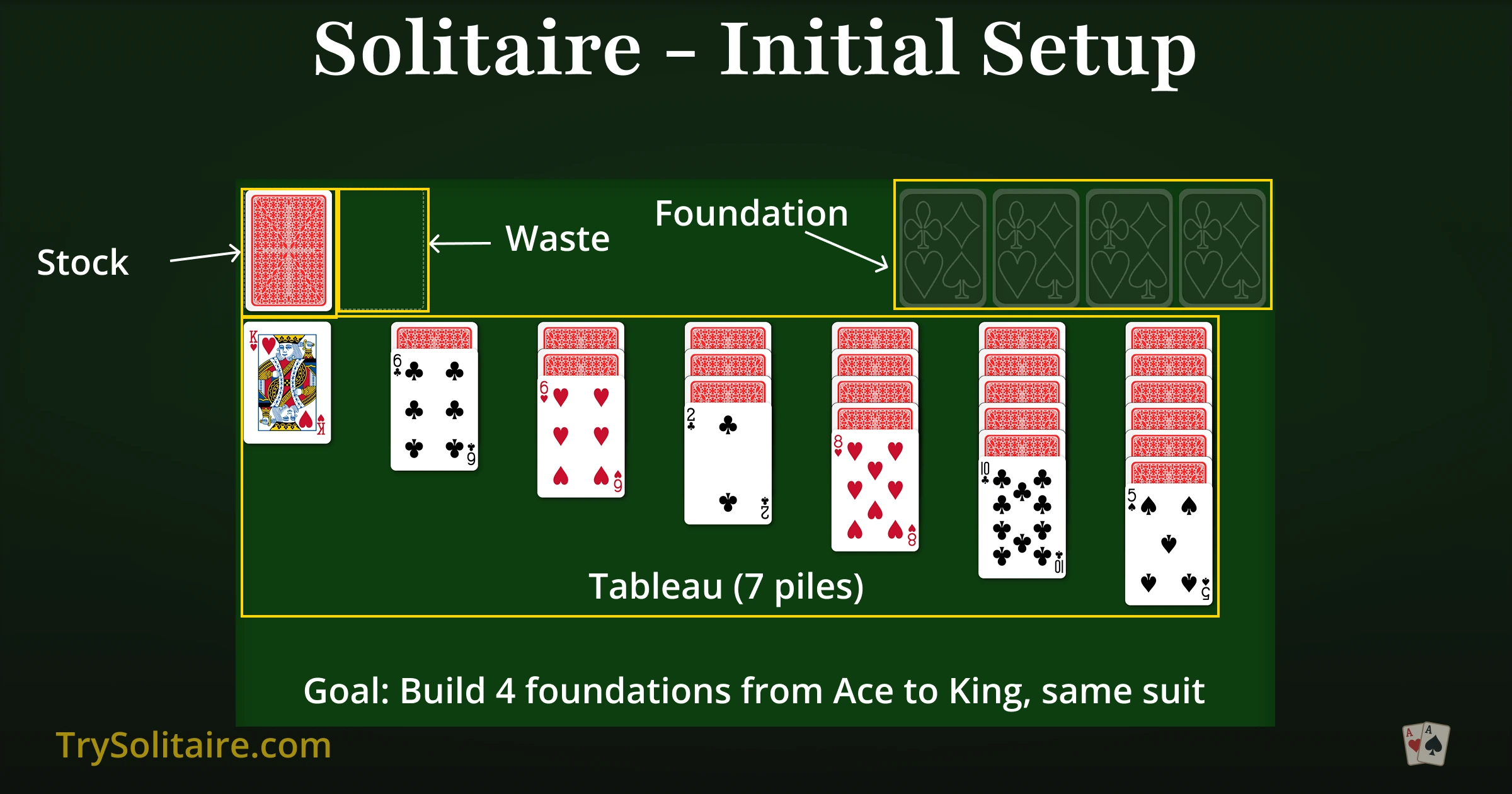
Quick Start: Play in 30 Seconds
- Goal: Move all 52 cards to the four foundations, building each suit from Ace to King.
- Tableau moves: Build columns down by alternating colors. A black 9 goes on a red 10.
- Empty columns: Only Kings can fill them.
- Stock: Click the deck (top-left) to flip cards to the waste. Cycle as many times as you need.
- Foundations: Move Aces up immediately. Build each foundation by suit, Ace to King.
Click Play Klondike and you're playing. Drag cards with the mouse on a computer or tap on a phone. Unlimited undo means you can experiment without losing progress.
Draw 1 vs Draw 3
Both modes use the same deals and the same ~82% theoretical winnability. The difference is access to the stock pile.
| Aspect | Draw 1 | Draw 3 |
|---|---|---|
| Stock draw | One card at a time | Three; only the top is playable |
| Theoretical win rate | ~82% | ~82% (same deals) |
| Practical win rate (skilled) | ~40% | ~10–15% |
| Recommended for | Beginners, casual play | The traditional challenge |
The win-rate gap comes from access. In Draw 3, useful cards land in the middle of a triplet and stay buried until you cycle the stock again. The deal itself is no harder; just harder to reach. Pick the mode in the new-game menu — both run on the same browser-side solver.
Six Strategies That Actually Work
1. Expose face-down cards before anything else
A face-down card is information you don't have. Flipping it is almost always more valuable than sending a card to the foundation. The exception: very early Aces and 2s, which serve no useful tableau role anyway.
2. Move Aces and 2s up immediately
Aces and 2s have no productive part to play in the tableau. They block the cards above them and they can't extend a sequence. Send them up the moment they're exposed.
3. Don't empty a column without a King ready
Empty tableau columns are valuable, but only if you can actually place a King in them. Emptying a column with no King available — and no face-down stack above one in another column — is wasted leverage.
4. Don't rush past the 5s to the foundation
A 4 sent to the foundation can no longer cover a 5. A 5 sent up can no longer cover a 6. Cards in the middle ranks (4 through 9) are often more useful in the tableau than on the foundation. A common rule from competitive Klondike play: keep each foundation no more than two ranks behind the lowest active card of the opposite color.
5. Cycle the stock before forcing a tableau move
If the tableau seems stuck, draw a few stock cards before making a desperation move. A card you haven't seen yet may be the move that opens the position. This matters most in Draw 3, where useful cards spend most of their time invisible.
6. Use the solver before you commit to a hard move
If you're about to make a move that feels risky, click the solver icon first. If the position is still green after the move, you're fine. If it turns red, you've just closed the only winning path — use Undo to back out and try a different line.
The Built-in Solver
About one in five Klondike deals is unwinnable no matter how well you play. Without a solver, you can spend ten minutes on a doomed game without knowing. Our solver runs entirely in your browser as a Web Worker — your moves never leave your device — and tells you in real time whether a winning path still exists.
- Green checkmark — A winning path exists from this position.
- Red X — No winning path. A move you made (or the deal itself) closed the door.
- Gold spinner — Analysis in progress (typically a few seconds).
- Deal Winnable — Pick a seed with a verified solution before any cards are dealt.
- Undo to Winnable — When the position becomes unsolvable, rewind to the last solvable state and try a different line without restarting.
How Often Can You Win?
Klondike's winnability has been a research question since the 1990s, and the literature is messier than most casual sources suggest. Here are the numbers that hold up to scrutiny.
Theoretical winnability
The most-cited result is from Yan, Diaconis, Rusmevichientong and Van Roy (2005), who used a Markov-chain Monte Carlo approach and concluded that approximately 82% of Klondike deals are solvable with perfect play. That figure applies to the deals themselves and is the same in Draw 1 and Draw 3 — the deck is the same; only access changes.
Practical winnability
What players actually achieve is much lower. Reasonable estimates from large-scale casual play data:
- Draw 1, skilled play: ~40% of games won.
- Draw 1, average player: 25–30%.
- Draw 3, skilled play: ~10–15%.
- Draw 3, average player: 5–10%.
The Draw 3 gap is access, not difficulty: the same deals are theoretically winnable, but the stock-pile constraint makes it harder to reach the moves you need.
Where the wrong numbers come from
Some sources confidently report figures like "21% of Draw 1 games are unwinnable, 70% of Draw 3 games are unwinnable." Those numbers are not from primary research; they appear to conflate theoretical winnability with practical win rates. The right framing is two separate facts: ~82% of deals are theoretically solvable in either mode, and skilled players win about half the deals their mode allows them to.
Why Play Klondike Here
- Browser-side solver. Most free Klondike sites don't ship one. Ours runs without sending data anywhere.
- Deal Winnable + Undo to Winnable. Skip impossible deals and recover from dead ends without losing progress.
- Daily challenge. Same deal for everyone that day — compare times with other players.
- Install as an app. Add it to your phone or computer's home screen. After install, it works without internet.
- Free, no sign-up, no download. Stats save locally; nothing leaves your device unless you install.
- Unlimited undo in both Draw 1 and Draw 3.
Klondike Variants
Klondike sits at the centre of a wide family of solitaire games. The siblings worth knowing:
- Yukon — same seven-column tableau, no stock pile. All 52 cards are dealt face-up across the columns, and you can move any face-up card with the cards beneath it as a single group, regardless of order.
- Vegas Klondike — standard rules with a scoring twist: you "buy" the deck for $52 and get $5 back per card sent to a foundation. Some Vegas rules limit you to one or three passes through the stock.
- Double Klondike — two decks, nine tableau columns, eight foundations. More space, more cards, fewer dead ends.
- East Haven — Klondike rules with a Spider-style stock: the stock deals one card to every column when you click it, instead of going to a waste pile.
- Spider — not strictly a Klondike variant, but the most popular alternative. Ten columns, build down regardless of colour, complete King-to-Ace runs to clear them.
- FreeCell — related more by convention than by rules: same deck and foundations, but every card is face-up and four "free cells" replace the stock. Almost every deal is winnable.
Frequently Asked Questions
Is Klondike Solitaire free to play?
Yes. Klondike on TrySolitaire is free, with no download or sign-up. The game runs in your browser and can be installed as an app on any device, after which it works without an internet connection.
What's the difference between Draw 1 and Draw 3?
Both modes use the same deals and the same theoretical winnability (~82% per Yan et al., 2005). Draw 1 flips one card at a time from the stock; Draw 3 flips three but only the top is playable. Practical win rates are about 40% in Draw 1 and 10–15% in Draw 3 because Draw 3 buries useful cards mid-triplet.
How does the built-in solver work?
The solver runs as a Web Worker entirely in your browser — your moves never leave your device. It explores the tree of legal moves from your current position and tells you in real time whether a winning path still exists. A typical check finishes in a few seconds.
Can I always start with a winnable deal?
Yes. Choose "Deal Winnable" in the new-game menu and the solver picks a seed with a verified solution before any cards are dealt. Available in both Draw 1 and Draw 3.
Who created the Microsoft Windows version of Klondike?
Wes Cherry, then a Microsoft intern, wrote the Windows version of Solitaire in the summer of 1988. Susan Kare designed the card faces. Microsoft bundled the game with Windows 3.0 in 1990, and a version of it has shipped with every Microsoft Windows release since.
Ready to Play?
Free, in your browser, no sign-up. Pick Draw 1 if you're learning, Draw 3 if you want the classic challenge.
Play Klondike Free