Double Klondike Solitaire — Free Online, Two Decks
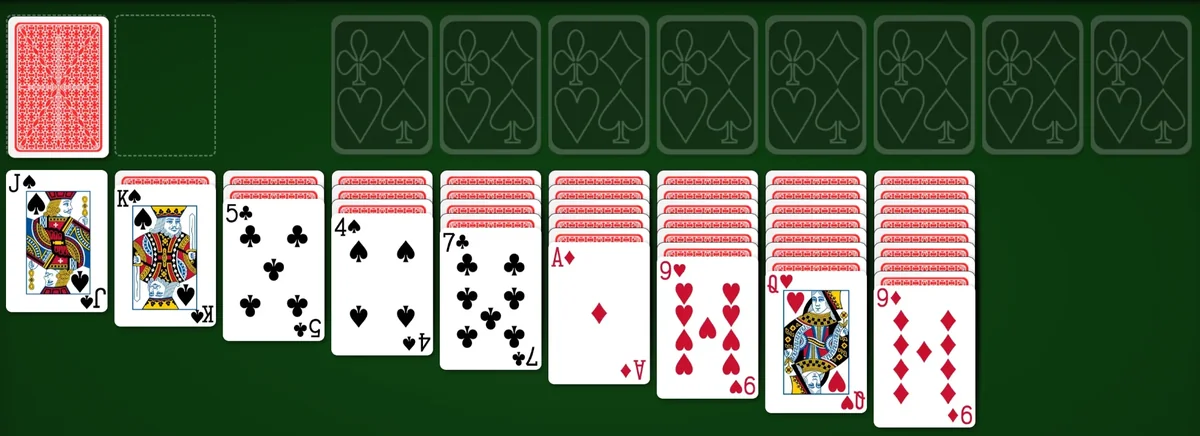
Double Klondike is Klondike played with two decks. Same move rules; bigger table. Nine tableau columns, eight foundations, and a 59-card stock replace Klondike's seven, four, and 24. Games run 15 to 30 minutes and the layout has room for sequences ten or more cards long. Draw 1 or Draw 3, unlimited undo, install-as-app for offline play. Free in your browser, no sign-up.
Quick Start: Play in 30 Seconds
- Goal: Move all 104 cards to the eight foundations, building each suit from Ace to King. Two foundations per suit means each suit gets completed twice.
- Tableau moves: Build columns down by alternating colors. A black 9 goes on a red 10. Multi-card moves are allowed when the sequence is already valid.
- Empty columns: Only Kings (or valid King-led sequences) can fill them.
- Stock: Click the deck (top-left) to flip cards to the waste. Cycle as many times as you need — there's no redeal limit.
- Foundations: Move Aces up immediately. Build each foundation by suit, Ace to King. Either Ace of spades can start either spades foundation.
Click Play Double Klondike and you're playing. Drag cards with the mouse on a computer or tap on a phone. Unlimited undo means you can experiment without losing progress.
Double Klondike vs Klondike: Side by Side
If you've played Klondike, you already know Double Klondike's rules. The differences are all structural.
| Aspect | Klondike | Double Klondike |
|---|---|---|
| Decks | One (52 cards) | Two (104 cards) |
| Tableau columns | 7 | 9 |
| Foundations | 4 (one per suit) | 8 (two per suit) |
| Stock pile | 24 cards | 59 cards |
| Typical game length | 5–15 min | 15–30 min |
| Longest possible sequence | 13 (King to Ace) | 13, but with more room to assemble |
| Draw modes | Draw 1, Draw 3 | Draw 1, Draw 3 |
The extra two columns and the larger stock are why Double Klondike feels more forgiving than its card count suggests. There's more room to build alternating-color sequences before they have to break, and the longer stock cycle gives you more chances to reach a buried Ace or low card.
Draw 1 vs Draw 3
Both modes use the same deals. The difference is access to the stock pile.
| Aspect | Draw 1 | Draw 3 |
|---|---|---|
| Stock draw | One card at a time | Three; only the top is playable |
| Practical win rate (skilled) | ~30–40% | ~10–15% |
| Recommended for | Learning, casual play | The traditional challenge |
The win-rate gap comes from access, not difficulty: the same deals are theoretically winnable in either mode. In Draw 3, useful cards land in the middle of a triplet and stay buried until you cycle the stock again. Pick the mode in the new-game menu.
What's the Best Double Klondike Strategy?
Four tactical shifts from single-deck Klondike. The classic Klondike rules (flip face-down cards first, send Aces up early, only empty a column when a King is ready) still apply — these are the additions.
Don't rush both copies of a card to the foundation
Two decks means two of every card. A 4 of spades sent up doesn't lock you out of covering a 5 of spades — there's another 4 still in play. This is the single biggest tactical difference from regular Klondike: the "don't send middle ranks up too early" rule is much weaker here. You can afford to clear the tableau more aggressively, but keep one copy of each mid-rank card in reserve when you can.
Plan multi-card moves before they're forced
With nine columns and longer sequences, you'll often have a six- or seven-card run to relocate. These moves are legal whenever the sequence is already valid (alternating colors, descending). Spot them early and keep an exit column in mind so you're not stuck when the move becomes urgent.
Build longer sequences when you can
With two decks, sequences of ten or more cards are common. They feel slow to assemble but they pay off — a long alternating-color block lets you re-arrange the board with a single move when the right King opens up.
Build foundations evenly
Eight foundations, two per suit. Letting one suit get five ranks ahead of another is rarely worth it. Even progress keeps mid-rank cards available in the tableau and avoids dead-ending the suit that fell behind.
How Often Can You Win?
Single-deck Klondike has a well-known solvability result — about 82% of deals are theoretically winnable, per Yan, Diaconis, Rusmevichientong and Van Roy (2005). Double Klondike has no equivalent peer-reviewed study. The numbers below are practical-play estimates from casual data, not theoretical proofs.
- Draw 1, skilled play: ~30–40% of games won.
- Draw 1, average player: 20–30%.
- Draw 3, skilled play: ~10–15%.
- Draw 3, average player: 5–10%.
The "easier than Klondike because there are more cards" intuition turns out to be roughly correct in practice: the extra columns and unlimited redeals compensate for the larger deck. Some sources claim Double Klondike is theoretically more winnable than single-deck Klondike because there are two of every card — that's plausible but not proven. Treat any specific solvability percentage you see online with the same skepticism you'd treat a single-deck "20% unwinnable" claim.
Why Play Double Klondike Here
- Native two-deck layout. The board is sized for nine columns and eight foundations on a single screen — no horizontal scrolling, no zoom-to-play.
- Draw 1 and Draw 3. Switch from the new-game menu between sessions. The deals run on the same engine in both modes.
- Unlimited undo. Walk back as many moves as you need. Useful for learning patterns; useful for recovering from a wrong send to the foundation.
- Install as an app. Add it to your phone or computer's home screen. After install, it works without internet.
- Daily challenge. Same deal for everyone that day — compare times with other players.
- Free, no sign-up, no download. Stats save locally; nothing leaves your device unless you install.
Related Two-Deck and Klondike-Family Games
Double Klondike sits in a small family of two-deck patience games and a larger family of Klondike-style single-deck games. Worth knowing:
- Klondike Solitaire — the single-deck original. Seven columns, four foundations, the same Draw 1 / Draw 3 split. Shorter games (5–15 min) and a published 82% theoretical solvability.
- Spider Solitaire — also two decks, but a different game. Build down regardless of color, clear by completing King-to-Ace runs in a single suit. Comes in 1-suit, 2-suit, and 4-suit difficulty.
- Yukon — single-deck Klondike with no stock pile. All 52 cards are dealt face-up across the columns; you can move any face-up card with everything beneath it as a single group.
- Forty Thieves — two-deck patience with stricter movement rules: only one card moves at a time and tableau builds down by suit, not by color. A harder challenge with two decks.
- FreeCell — single deck, every card face-up, four "free cells" instead of a stock pile. Almost every deal is winnable. Worth playing if you want to feel skilled rather than lucky.
Frequently Asked Questions
Is Double Klondike Solitaire free to play?
Yes. Double Klondike on TrySolitaire is free, with no download or sign-up. The game runs in your browser and can be installed as an app on any device, after which it works without an internet connection.
What's the difference between Double Klondike and regular Klondike?
Two decks instead of one. Double Klondike uses 104 cards across nine tableau columns and eight foundations (two per suit), where Klondike uses 52 cards across seven columns and four foundations. The move rules are identical — build the tableau down by alternating colors, build the foundations up by suit from Ace to King. Games last 15 to 30 minutes versus 5 to 15 for Klondike.
Is Double Klondike harder than Klondike?
It depends on what you measure. More cards to track, but two extra tableau columns and a larger waste pile compensate. With skilled play and Draw 1, practical win rates land in roughly the same range as single-deck Klondike — around 30 to 40 percent. Draw 3 drops that to about 10 to 15 percent in either game.
Should I play Draw 1 or Draw 3?
Draw 1 if you're learning the game or want a more reliable session. Draw 3 if you want the traditional challenge. The deals are the same in both modes; Draw 3 just buries useful cards in the middle of each triplet, so you cycle the stock more before they become reachable.
How long does a typical Double Klondike game take?
Most games take 15 to 30 minutes — roughly two to three times Klondike. The longer playtime is the main reason some players prefer it: a more involved session per game rather than a quick break. Use the unlimited undo if you want to experiment without restarting.
Is Double Klondike the same as Spider Solitaire?
No. Both use two decks, but the rules are different. Spider builds down regardless of suit and clears the board by completing King-to-Ace runs in a single suit. Double Klondike builds down by alternating colors (red on black, black on red) and builds the foundations up from Ace to King by suit.
Ready to Play?
Free, in your browser, no sign-up. Pick Draw 1 if you're learning, Draw 3 if you want the classic challenge.
Play Double Klondike Free