Play Double Klondike Solitaire — Two Decks, Nine Columns, Eight Foundations
Double Klondike is Klondike played with two decks. Same rules; bigger table. Nine tableau columns, eight foundations, and a 59-card stock replace Klondike's seven, four, and 24. The game is longer (15–30 minutes) and the layout has space for sequences ten or more cards long. Free in your browser, no sign-up. Works offline once the page has loaded.
How Do You Play Double Klondike?
Goal: build all eight foundations from Ace to King by suit. Two foundations per suit means each suit gets completed twice.
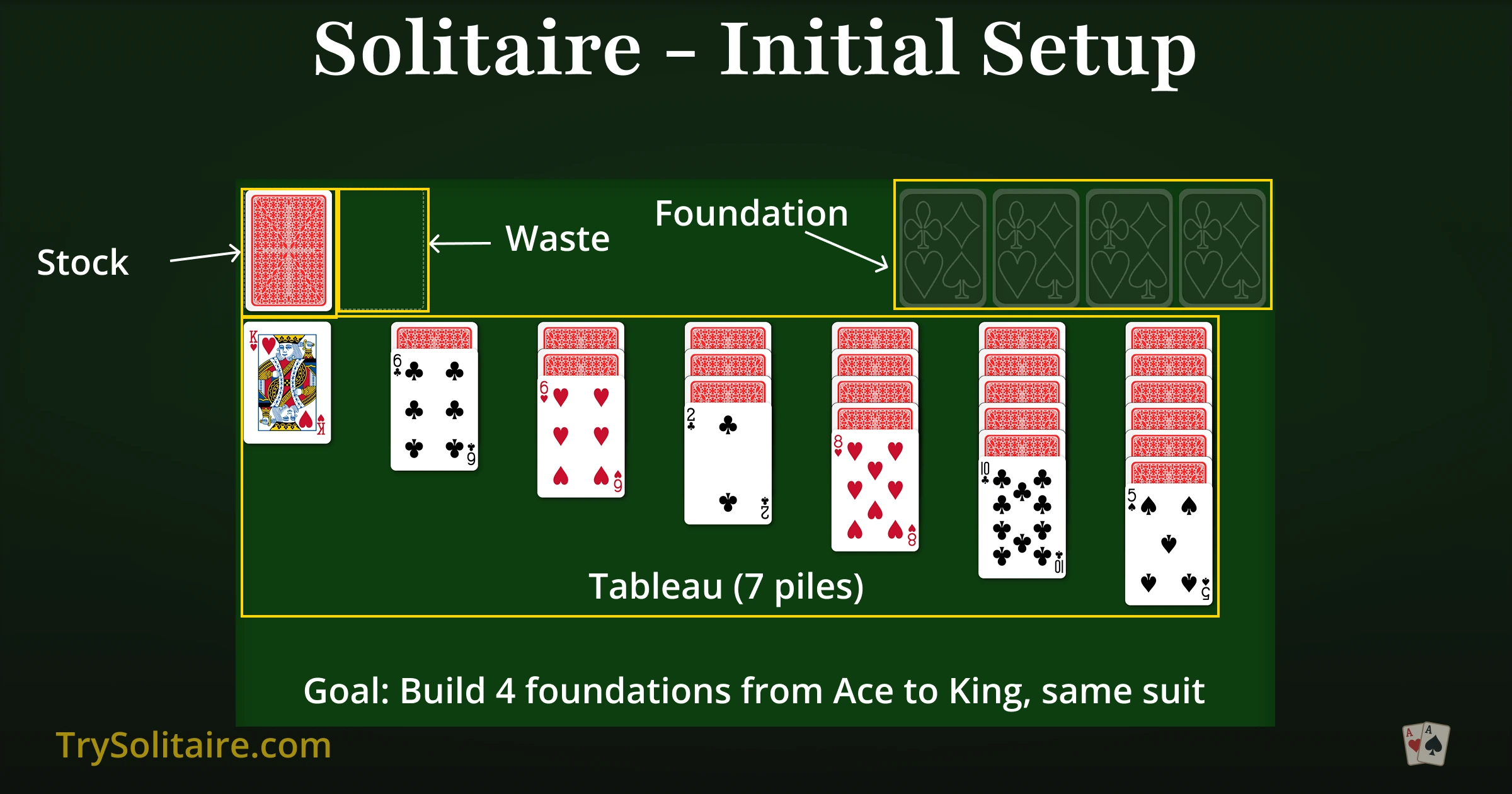
Setup
- Tableau: nine columns dealt 1, 2, 3 ... 9 cards. Only the top card of each column is face-up.
- Stock: 59 cards face-down in the corner.
- Waste: one card flipped at a time (Draw 1) or three at a time (Draw 3).
- Foundations: eight empty spaces, two per suit. Build up Ace to King.
Rules
- Build tableau columns down by alternating color. Black 9 on red 10. Red Queen on black King.
- Move properly ordered sequences as a single block when alternating colors hold throughout.
- Only Kings (or sequences starting with a King) can fill an empty tableau column.
- Foundations build up by suit, Ace to King. Each suit completes twice.
- The stock recycles unlimited times in our version.
How Does Double Klondike Differ From Klondike?
Same rules, different scale. The bigger board changes which moves matter.
| Aspect | Klondike | Double Klondike |
|---|---|---|
| Decks | 1 (52 cards) | 2 (104 cards) |
| Tableau columns | 7 | 9 |
| Foundations | 4 | 8 (two per suit) |
| Stock | 24 cards | 59 cards |
| Game length | 5–10 minutes | 15–30 minutes |
Practical skilled win rates land around ~30–40% in Draw 1 and ~15–25% in Draw 3 — broadly similar to single-deck Klondike, where Yan et al. (2005) put theoretical solvability at ~82%. Two extra columns and unlimited redeals partly offset the doubled card count.
What's the Best Double Klondike Strategy?
- Don't rush both copies of a card to the foundation. One copy in the tableau is mobility. Sending both up early closes off sequences you'll need later.
- Expose face-down cards before drawing from stock. A face-down card you flip is information; a stock card you draw is the same card you'd have drawn anyway.
- Build longer sequences when you can. With two decks, sequences of 10+ cards are common. Long blocks let you re-arrange the board with a single move.
- Build foundations evenly. Letting one suit get five ranks ahead of another is rarely worth it; even progress keeps mid-rank cards available in the tableau.
About This Version
Choose Draw 1 or Draw 3 before you start. Unlimited undo, statistics by mode, and a daily challenge that gives every player the same deal that day. Install it as an app from your browser menu to play offline.
Other Solitaire Games to Try
- Klondike — the classic single-deck version
- Spider — two decks, ten columns, suit-based sequences
- FreeCell — every card visible, almost every deal winnable
- Yukon — seven columns, all cards face-up, no stock
- Forty Thieves — two decks, ten columns, much harder