Pyramid Solitaire: Master the Matching Pairs Game
Clear the pyramid by pairing cards that add up to 13 in this classic solitaire variant
Last Updated: July 19, 2026 | Reading Time: 8 minutes
Quick Summary: Pyramid Solitaire is one of the most approachable solitaire variants, where you clear a pyramid of 28 cards by matching pairs that add up to 13. Unlike traditional solitaire sequencing, this math-based pairing mechanic makes it perfect for beginners while still offering strategic depth for experienced players.
What is Pyramid Solitaire?
Pyramid Solitaire is a unique solitaire variant that replaces traditional card sequencing with mathematical pairing. Instead of building suited sequences, you clear a pyramid-shaped tableau by removing pairs of cards that add up to 13. This simple yet engaging mechanic makes Pyramid Solitaire one of the most accessible solitaire games for newcomers.
The game uses a single standard 52-card deck, arranged into a 28-card pyramid with the remaining 24 cards forming the stock pile. Success requires a combination of strategic planning, mathematical thinking, and a bit of luck.
Why Play Pyramid Solitaire? Perfect for quick gaming sessions (5-10 minutes per game), great for practicing mental math, easier win rate than Klondike or Spider, and offers satisfying gameplay without being too complex.
Setup & Game Layout
The Pyramid Tableau
Deal 28 face-up cards in a pyramid formation:
- Row 1 (Top): 1 card
- Row 2: 2 cards (overlapping the top card)
- Row 3: 3 cards
- Row 4: 4 cards
- Row 5: 5 cards
- Row 6: 6 cards
- Row 7 (Base): 7 cards (fully exposed)
Each row overlaps the cards above it, creating the classic pyramid shape. Only cards that aren't covered by any other cards are considered "exposed" and playable.
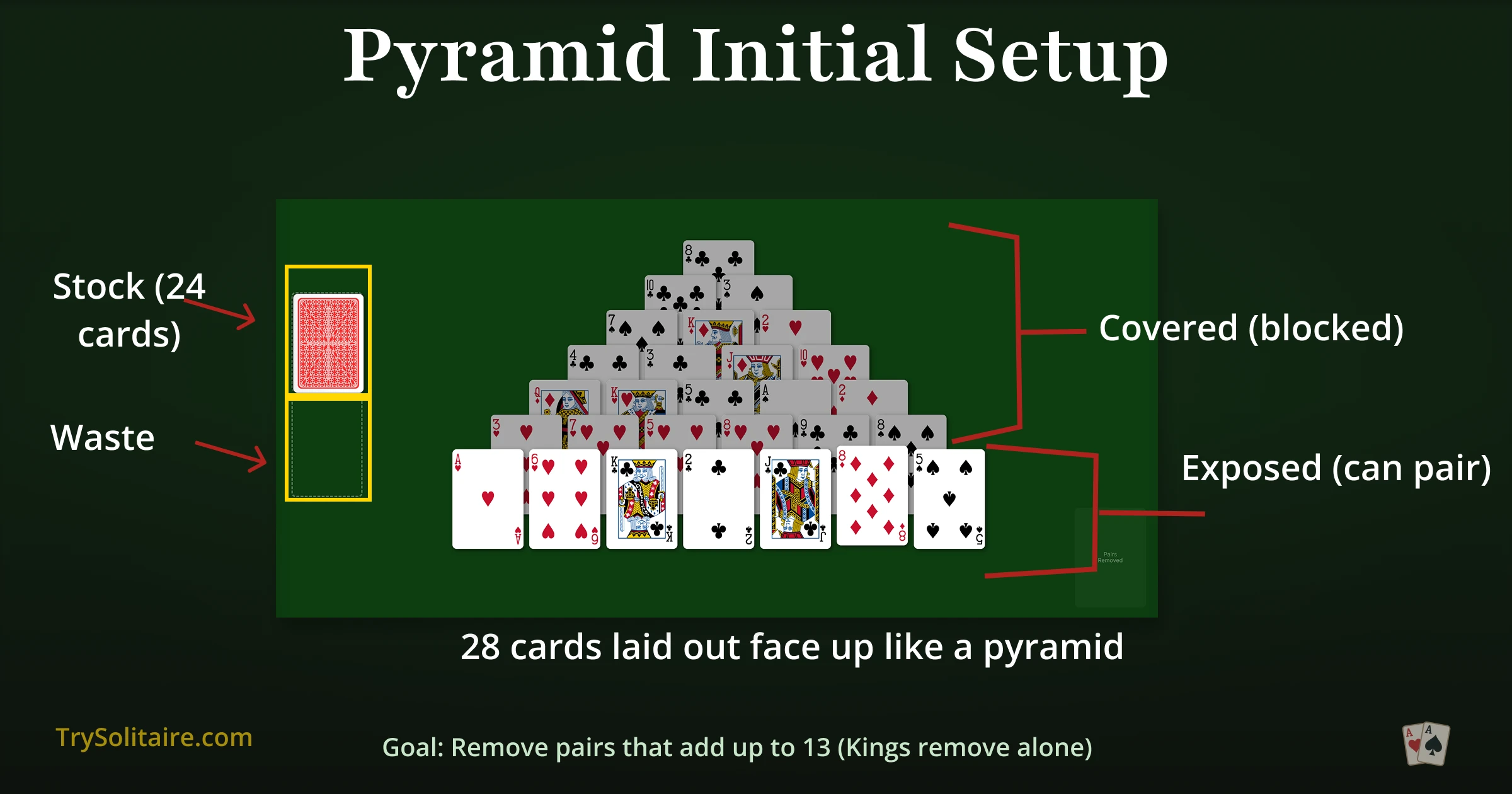
Pyramid Setup Details
- Total Cards: 52 (one complete deck)
- Pyramid Structure: 28 cards in 7 rows
- Row 1: 1 card (peak)
- Row 2: 2 cards
- Row 3: 3 cards
- Row 4: 4 cards
- Row 5: 5 cards
- Row 6: 6 cards
- Row 7: 7 cards (base - all exposed)
- Stock Pile: 24 cards face-down
- Waste Pile: Empty at start
- Pairing Rule: Remove pairs that add up to 13
- Card Values: A=1, 2-10=face value, J=11, Q=12, K=13
- King Special Rule: Kings (13) remove alone without pairing
- Example Pairs: Q+A, J+2, 10+3, 9+4, 8+5, 7+6
- Exposed Cards: Only cards not overlapped by others can be played
Other Game Areas
- Stock Pile: The remaining 24 cards, placed face-down
- Waste Pile: Where stock cards are flipped, one at a time
- Foundation/Discard: Where matched pairs are placed (removed from play)
Card Values
- King: 13 points (removed alone, no pair needed!)
- Queen: 12 points (pairs with Ace)
- Jack: 11 points (pairs with 2)
- 10: 10 points (pairs with 3)
- 9: 9 points (pairs with 4)
- 8: 8 points (pairs with 5)
- 7: 7 points (pairs with 6)
- 6 through Ace: Face value (6 down to 1)
Rules & How to Play
Objective
Clear all 28 cards from the pyramid by pairing exposed cards that add up to 13, before cycling through the stock pile too many times.
Basic Gameplay
- Identify Exposed Cards: Only cards not overlapped by other cards can be played. At the start, all 7 cards in the bottom row are exposed.
- Find Matching Pairs: Look for two exposed cards that add up to 13. Suits don't matter—only the rank counts. For example: Queen (12) + Ace (1), Jack (11) + 2, 10 + 3, 9 + 4, 8 + 5, 7 + 6.
- Remove Kings Immediately: Kings are worth 13, so they can be removed by themselves without needing a pair.
- Use the Stock Pile: If you can't make any pairs from the pyramid, flip one card from the stock to the waste pile. You can pair this waste pile card with any exposed pyramid card.
- Cycle Through Stock: You can go through the stock pile up to three times (in most variants). After the third pass, if cards remain on the pyramid, you lose.
Valid Pairs
Any of these combinations add up to 13:
- King (solo removal)
- Queen + Ace (12 + 1)
- Jack + 2 (11 + 2)
- 10 + 3
- 9 + 4
- 8 + 5
- 7 + 6
Winning & Losing
You Win: When all 28 pyramid cards have been removed.
You Lose: If you cycle through the stock pile three times and still have pyramid cards remaining with no valid pairs to make.
Winning Strategies
1. Remove Kings Immediately
Since Kings don't need a pair and are worth exactly 13, remove them as soon as they're exposed. This frees up space and uncovers new cards without using any other resources.
2. Clear Row by Row
Focus on clearing complete rows from bottom to top when possible. This systematic approach ensures you don't accidentally block cards you'll need later. Working row by row gives you maximum flexibility and exposes new cards strategically.
3. Prioritize Pyramid Over Stock
Your primary goal is clearing the pyramid, not using the stock pile. Save stock cards for later moves when you've exhausted pyramid-only pairs. The stock is your backup resource—don't waste it early.
4. Look Ahead to Covered Cards
When choosing between multiple valid pairs, consider what cards will be uncovered. If removing one pair reveals important cards (like Kings or cards that complete other pairs), prioritize that move.
5. Don't Jump at the First Match
Just because you CAN make a pair doesn't mean you SHOULD. Evaluate whether that pair helps your overall strategy or if it might block better moves later.
6. Delay Stock/Waste Combinations
If the stock card can pair with a pyramid card, you don't have to make that pair immediately. Those cards will still be available later if they don't help clear critical pyramid positions now.
7. Watch for Buried Multiples
Remember that each rank has only four cards in the deck and only one matching rank to pair with it. If multiple cards of the same rank are buried deep in the pyramid, you risk running past their matches in the stock pile.
Expert Tips
Mental Card Tracking
Keep a mental note of which ranks you've seen. If you've already removed three 7s, for example, you know there's only one 6 that can pair with the remaining 7. This helps you prioritize moves.
Identify "Blockers"
Some pyramid positions block multiple cards beneath them. Prioritize removing these blocker cards to maximize the number of newly exposed cards.
Plan 2-3 Moves Ahead
Before making a pair, visualize what cards will be exposed and whether they'll create new pairing opportunities. Sequential planning prevents dead ends.
Start with Bottom Row Options
Since all bottom row cards are exposed, explore all possible pairings there first. This gives you the most information about what's available before committing to a strategy.
Popular Variations
Relaxed Pyramid Solitaire
The most popular variation. You only need to clear the pyramid—cards can remain in the stock and waste piles. This makes the game significantly more winnable and less frustrating.
Giza Pyramid
Uses a larger pyramid (45 cards instead of 28), requiring two decks. More challenging with longer gameplay sessions.
Apophis (Triple Waste)
Similar to standard Pyramid, but you get three waste piles instead of one, making the game much easier and more forgiving.
Par Pyramid
Scoring variant where you earn points for each pair removed, with a "par score" goal to beat. Adds competitive element without changing core rules.
Frequently Asked Questions
How many cards are in the pyramid?
28 cards form the pyramid (1+2+3+4+5+6+7 = 28), with 24 cards remaining in the stock pile.
Can I move cards around in the pyramid?
No, cards stay in their pyramid positions. You can only remove pairs that add up to 13.
What percentage of Pyramid Solitaire games are winnable?
In standard Pyramid, about 15-20% of games are winnable with perfect play. In Relaxed Pyramid (only need to clear the pyramid), the win rate increases to 50-70%.
Do suits matter in Pyramid Solitaire?
No, suits are irrelevant. Only the card ranks matter for making pairs that add up to 13.
Can I pair two waste pile cards together?
No, you can only pair pyramid cards with other pyramid cards, or pyramid cards with the top waste pile card.
Is Pyramid Solitaire easier than Klondike?
Yes, Pyramid Solitaire is generally considered easier to learn and more beginner-friendly than Klondike, though it still requires strategic thinking to win consistently.
Ready to Play Pyramid Solitaire?
Now that you understand the rules and strategies, test your skills with our free online Pyramid Solitaire game!
Play Pyramid Solitaire Free →