TriPeaks Solitaire Guide: Rules, Strategy, History
TriPeaks is a fast, sequence-driven solitaire built around three overlapping pyramids and a single deck. You clear pyramid cards by matching them one rank above or below the waste pile, suits ignored, and your score depends almost entirely on how long you can keep that sequence running. We measured 97% of deals as solvable with perfect play — far above Klondike's ~82% — which is why TriPeaks feels generous, even forgiving, while still rewarding planning. This guide covers the rules, the streak-multiplier scoring system, six strategies, what an exhaustive solver says about how often it can be won, and the Microsoft Entertainment Pack 3 origin story.
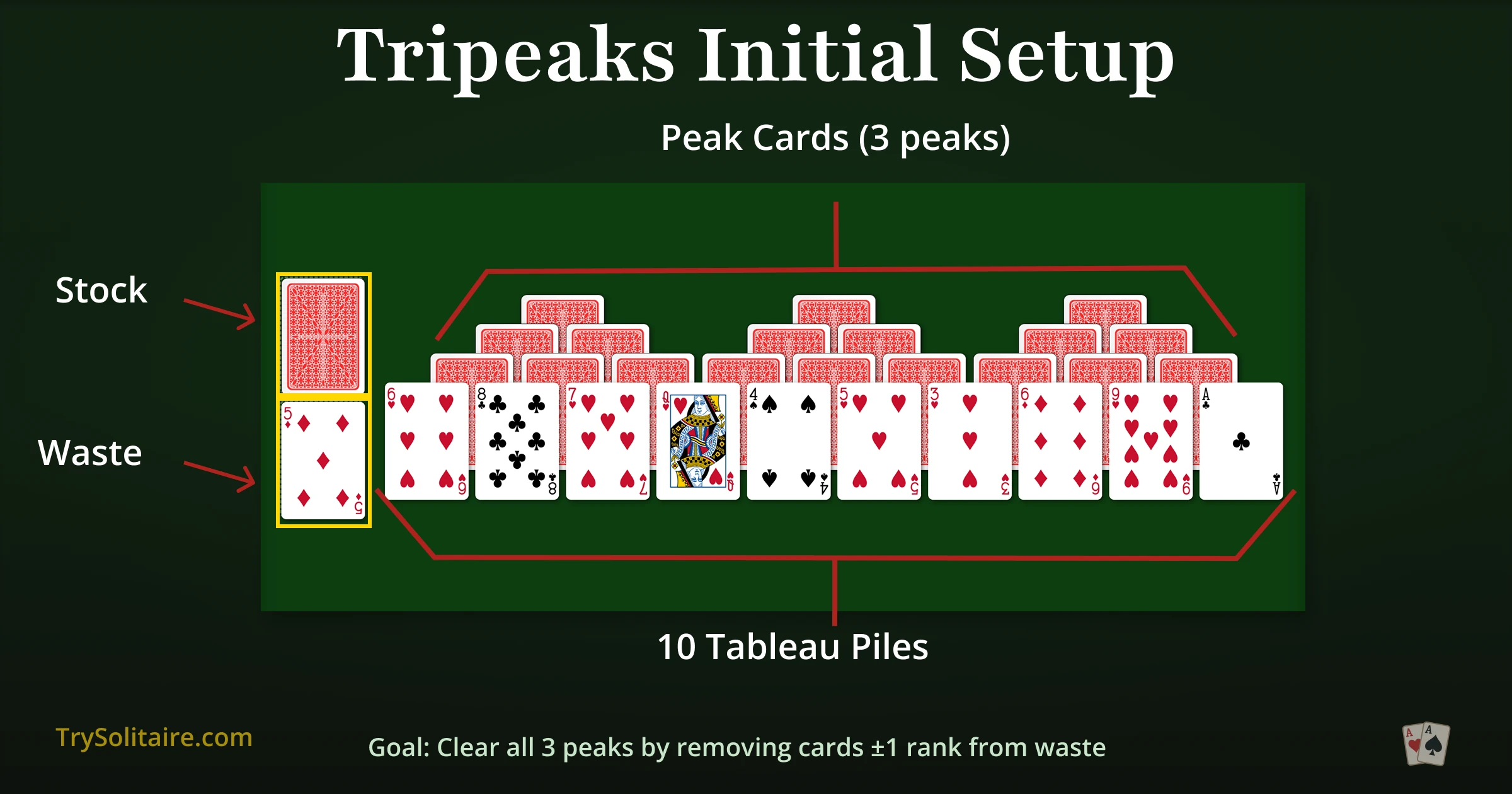
Table of Contents
What Is TriPeaks?
TriPeaks is a single-deck solitaire played with 52 cards, but only 28 of them sit on the board at the start. Those 28 form three overlapping pyramids, each three rows deep. The other 24 split into a face-down stock pile of 23 cards and a single face-up waste card that opens play.
The defining mechanic is the matching rule: any uncovered pyramid card whose rank is one above or one below the top of the waste pile can be played in a single click. Suits are ignored. This is what lets the game move so quickly — once a sequence starts, you can chain card after card without breaking pace. The chain is also where most of your score lives, because the streak multiplier rewards consecutive plays exponentially.
The Layout
The 52-card deck is divided across four areas:
- Three pyramids: 28 cards in three overlapping triangular formations. Each pyramid has 1 card at the peak, 2 in the middle row, and 3 in the base row. The pyramids share no cards; they sit side by side and overlap only visually.
- Bottom row: 10 face-up cards along the base of the three pyramids. These are not technically part of the pyramids but are in play from the first move. They cover most of the base-row pyramid cards above them.
- Stock: 23 cards face-down in the bottom-left. Click to flip one to the waste.
- Waste: a single pile to the right of the stock. Only the top card is in play. The first waste card is dealt face-up at the start of the game.
You win when all 28 pyramid cards (and the 10 bottom-row cards covering them) have been removed. The stock and waste don't need to be empty — anything still there at the end just costs you a small per-card penalty.
The Rules
Card matching
Click any fully uncovered card whose rank is one above or one below the top waste card. Suits are irrelevant. A 7 can be played on a 6 or an 8, a 6 on a 5 or 7, and so on. Each card you play becomes the new top of the waste, and the next move uses that as its reference.
The Ace–King wrap
Rank wraps around the deck. King connects to Ace, Ace connects to 2, in either direction. So you can play a King on an Ace, an Ace on a King, an Ace on a 2, or a 2 on an Ace. Without this rule, edge ranks would dead-end too often and long streaks would be rare.
Coverage
A pyramid card is playable only when no other card overlaps it. The cards stack visually so the bottom row covers the pyramid base rows, the base rows cover the middle rows, and the middle rows cover the three peaks. At deal time, only the 10 bottom-row cards are in play. Every removal uncovers something underneath, and the peaks are usually the last cards left standing.
Stock and waste
When no pyramid card matches, click the stock to draw the next card to the waste. There is no recycle — once the stock empties, you keep playing with whatever waste card is on top, but you have no further draws. If the position locks up before you've cleared all 28 pyramid cards, the game is lost.
Winning and losing
You win the moment the last pyramid card is cleared. You lose if no playable move exists and the stock is empty.
Scoring
TriPeaks rewards sequences far more than individual cards. Most of your final score comes from one or two long streaks, not from clearing the same number of cards across many short runs.
| Event | Points |
|---|---|
| Pyramid card cleared | 50 × current streak multiplier |
| Streak multiplier | Starts at 1, +1 per consecutive card, resets to 1 on stock draw |
| Peak cleared (×3) | +100 each |
| Game won | +1,000 |
| Card left in stock | −25 each |
A 10-card streak alone scores 50 + 100 + 150 + 200 + 250 + 300 + 350 + 400 + 450 + 500 = 2,750 points. Spread the same ten cards across five short streaks and you score 5 × (50 + 100) = 750 — less than a third. The math is what makes streak management the central skill of the game.
Your top scores save locally per device. There's no leaderboard sync; the goal is to beat your own previous best.
Six Strategies That Actually Work
1. Always extend before you draw
Every stock draw resets your streak. Before clicking the stock, scan every uncovered pyramid card to confirm none of them is one rank away from the current waste. New players draw too soon and leave 200–500 points on the table per game.
2. Prefer plays that uncover new cards
When two cards in the pyramid are both legal, play the one that exposes the most new cards underneath. A second-row card usually uncovers two cards below it; a base-row card uncovers fewer or none. More uncovered cards means more potential matches for the next play.
3. Look ahead before committing direction
When you can play either a 6 or an 8 on the current 7, the better choice is whichever one continues longer. If you can see a 5–4–3–2 chain available downward but only a single 9 upward, the 6 path scores more. Five seconds of scanning beats five seconds of regret.
4. Work the three peaks evenly
Clearing one peak entirely while ignoring the others usually leaves you stuck — the remaining cards cluster in the same rank range and starve your sequences of variety. Spread your removals across all three pyramids so every rank stays represented for as long as possible.
5. Mind the edge ranks
Aces and Kings only match two other ranks each (2/Q for King, K/2 for Ace). When you draw an edge rank from stock, check whether the necessary continuation cards are visible before you commit to building from it. Trapped on a King with no Queens or Aces in sight is one of the most common ways winnable games are lost.
6. Use Undo as a learning tool
Unlimited undo is part of the game, not a cheat. When two paths look close, take one — and if it dead-ends, undo back and take the other. Over time you'll start recognising the pattern from the position, and the undos drop away naturally.
How Often Can You Win?
TriPeaks is widely cited at "around 90% of deals winnable," but that figure comes from play data rather than a solver, and it understates the game. We ran an exhaustive search over 10,000 random deals of the version on this site: 9,704 were solvable, none left undecided. That is 97.0%, well above Klondike's ~82% (Yan et al., 2005). The solver code is in the repository so the number can be re-derived rather than taken on trust.
Solvable is not the same as won. The solver searches every branch before committing to a move; you do not. Practical win rates from skilled players land in the 70–85% range, and the gap from 97% is exactly what you would expect: almost every deal can be cleared, but clearing it means catching the long-streak line instead of drawing from stock at the first stall. Average players typically win 50–65%.
If you're winning more than ~85% of deals, you're either getting lucky on the deal distribution or you're an exceptional player; the ceiling is real.
TriPeaks vs Pyramid Solitaire
The two games look similar, but they play nothing alike.
| Aspect | TriPeaks | Pyramid |
|---|---|---|
| Matching rule | ±1 rank, suits ignored | Pairs sum to 13 |
| Pyramid count | Three overlapping | One single pyramid |
| Wrap-around | King–Ace–2 legal | King removed alone (sums to 13) |
| Measured solvability | 97.0% | 67.5% |
| Practical win rate | ~70–85% with skill | ~10–15% even with skill |
| Game length | 3–7 minutes | 5–10 minutes |
| Feel | Fast, streak-driven | Slow, calculation-heavy |
TriPeaks rewards reading the layout and committing to a long sequence. Pyramid rewards arithmetic and patience. They share a triangular silhouette and almost nothing else. Try Pyramid via our Pyramid version if you want the contrast.
A Short History
TriPeaks is credited to Robert Hogue, a Microsoft developer who designed it in the late 1980s. It first reached a wide audience in Microsoft Entertainment Pack 3 (1991), the third instalment of the Windows games collection that also introduced FreeCell, SkiFree and Chip's Challenge to a generation of office PCs.
The game stayed niche for the next two decades — present in card-game anthologies, not part of the default Windows install. That changed in 2012, when Microsoft launched the Microsoft Solitaire Collection bundled with Windows 8. TriPeaks was one of five included variants alongside Klondike, Spider, FreeCell and Pyramid, and the bundle has shipped with every Windows release since. Its second wave of mainstream attention came from mobile free-to-play apps in the 2010s, which built progression metas around the streak-scoring core.
The "Tri-" in the name simply refers to the three peaks. The peaks aren't a metaphor for anything in particular — Hogue was looking for a layout with more starting variety than Pyramid's single triangle, and three triangles fit neatly across a 1991-era 640×480 monitor.
Frequently Asked Questions
What percentage of TriPeaks games are winnable?
We measured it: 97.0% of deals are solvable. An exhaustive solver mirroring this version's rules cleared 9,704 of 10,000 random deals, with none left undecided. That is a ceiling for perfect play with full lookahead, not a win rate — skilled players land around 70–85% in practice. The figure is well above Klondike's ~82% solvability (Yan et al., 2005), and above the ~90% TriPeaks is usually cited at, which comes from play data rather than a solver. The high ceiling is the reason the game feels generous compared to Klondike or Pyramid.
Do suits matter in TriPeaks?
No. Only rank matters. Any 6 plays on any 5 or any 7. Suits are purely cosmetic. The simplification is what lets sequences run as fast as they do — you only have to scan rank, not suit-and-rank.
Can a King play on an Ace?
Yes. TriPeaks treats the rank order as a loop: King–Ace–2 is legal in either direction. So King plays on Ace, and Ace plays on King. Without the wrap rule, edge ranks would dead-end too often and long streaks would be rare.
How does the streak multiplier work?
Each card you play scores 50 points × your current streak. The streak starts at 1 and increases by 1 with every consecutive pyramid card you clear. Drawing from stock resets it to 1. A 10-card streak therefore scores 50+100+150+...+500 = 2,750 points — far more than ten separate plays would.
Where does TriPeaks come from?
TriPeaks is credited to Robert Hogue, who designed it in the late 1980s. It first reached a wide audience in Microsoft Entertainment Pack 3 (1991), then returned to mainstream Windows in the Microsoft Solitaire Collection that ships with Windows 8 and later. The three-peak layout is the visual signature; the ±1-rank matching rule is what differentiates it from Pyramid (where pairs sum to 13).
How is TriPeaks different from Pyramid Solitaire?
Pyramid pairs cards that sum to 13 — A+Q, 2+J, 3+10 and so on, with Kings removed alone. TriPeaks instead matches cards one rank above or below the waste pile, regardless of suit. TriPeaks has three peaks; Pyramid has one. TriPeaks plays faster and is solvable more often (97% against 67.5% for Pyramid, both measured with the same solver).
Related Solitaire Guides
- Klondike Solitaire Guide — the classic seven-column Microsoft Solitaire
- Spider Solitaire Guide — two decks, ten columns, suit-based sequences
- FreeCell Solitaire Guide — every card visible, almost every deal winnable
- Pyramid Solitaire Guide — the single-pyramid sums-to-13 cousin
- General Solitaire Strategy — patterns that work across the family