Yukon Solitaire, also known as Yukon Patience, is the ideal middle ground between Klondike's accessibility and Russian Solitaire's brutal difficulty. With no stock pile and the unique ability to move any face-up card with all cards on top of it, Yukon transforms classic solitaire into a pure strategy game where every decision matters. All 52 cards are visible from the start, eliminating luck and rewarding careful planning.
Move all 52 cards to four foundation piles, building each suit from Ace to King. Success requires mastering the unique Yukon movement rules and planning multiple moves ahead to expose face-down cards while building foundations.
🏗️ Setup and Layout
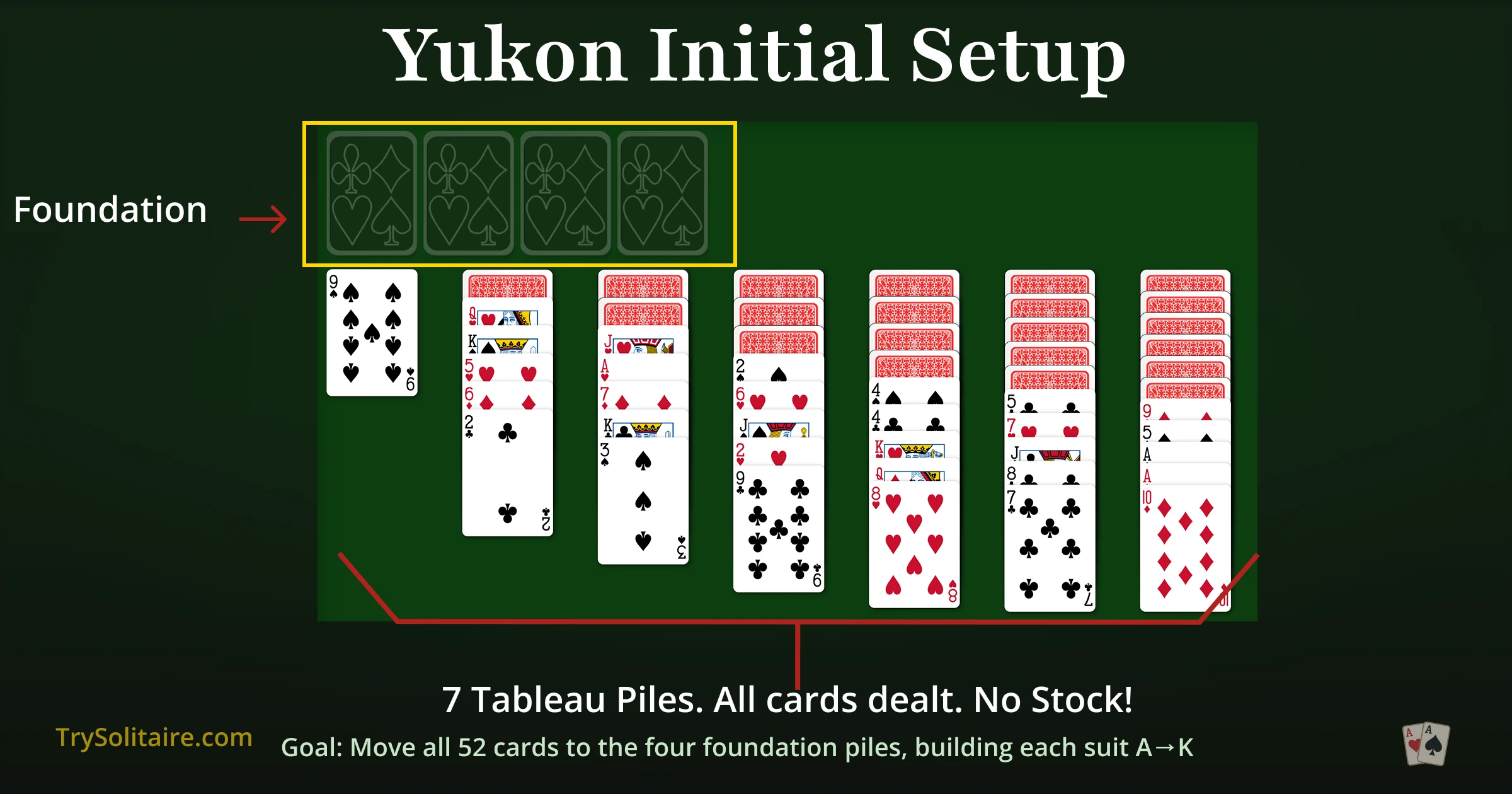
Yukon begins with a unique deal that distinguishes it from Klondike:
The Tableau Deal
Column 1: 1 card face-down, 1 card face-up on top (2 cards total)
Column 2: 2 cards face-down, 1 card face-up on top, plus 4 additional face-up cards (7 cards total)
Column 3: 3 cards face-down, 1 card face-up on top, plus 4 additional face-up cards (8 cards total)
Column 4: 4 cards face-down, 1 card face-up on top, plus 4 additional face-up cards (9 cards total)
Column 5: 5 cards face-down, 1 card face-up on top, plus 4 additional face-up cards (10 cards total)
Column 6: 6 cards face-down, 1 card face-up on top, plus 4 additional face-up cards (11 cards total)
Column 7: 7 cards face-down, 1 card face-up on top, plus 4 additional face-up cards (12 cards total)
📊 Card Distribution:
Total cards: 52 (all cards in play from the start)
Face-down cards: 28 (1+2+3+4+5+6+7)
Face-up cards: 24 (1 on each column + 4 additional on columns 2-7)
Stock pile: None - this is key!
Yukon Solitaire - Initial Setup
Unique Feature: ALL 52 cards dealt to tableau at start - No stock pile!
Yukon Initial Layout: All 52 cards dealt to tableau - Column 1 has 2 cards (1 down, 1 up), Columns 2-7 have 7-12 cards each (varying face-down + 1 face-up + 4 extra face-up). No stock pile! The 4 foundations (top) start empty.
The Foundations
Four empty foundation piles where you build each suit independently from Ace through King.
🎴 The Game-Changing Rule: The Yukon Move
The Yukon Move Explained:
In Yukon, you can move any face-up card along with all cards stacked on top of it, regardless of whether those cards form a proper sequence. The only requirement is that the card you're moving (the bottom card of the group) must be placed on a valid target (one rank higher, opposite color).
Example: If you have a column with 7♠ (bottom), then K♦, 3♣, and A♥ stacked on top, you can move the 7♠ + K♦ + 3♣ + A♥ (all four cards) onto an 8♥ in another column.
This is fundamentally different from Klondike, where you can only move properly sequenced cards (descending rank, alternating colors). The Yukon Move creates unique strategic opportunities and is the defining mechanic of the game.
The "Yukon Move" - Key Game Mechanic
Revolutionary Rule: Move ANY face-up card along with ALL cards on top of it - even if not properly sequenced!
✓ VALID Yukon Moves:
Move unsequenced cards: Example: 5♦ with 9♣ on top → both move to 6♠ (even though 5♦ and 9♣ aren't sequential!)
Move single cards: Example: 7♥ alone → moves to 8♣ (standard alternating color move)
Alternating Colors: Red on black, black on red (just like Klondike)
Yukon Move: Any face-up card + all cards above it can be moved together
Valid Placement: The card being moved must go on a card one rank higher and opposite color
Example: Red 6 can go on black 7; black Queen can go on red King
Empty Column Rules
Only Kings (or groups headed by Kings) can fill empty columns
When moving a King to an empty column, all cards on top of it move too
Empty columns are extremely valuable for reorganizing the tableau
Foundation Building
Build by suit in ascending order (A → 2 → 3 → ... → K)
Each foundation must be a single suit (all hearts, all spades, etc.)
Cards can be moved back to tableau if needed (rarely useful)
Win when all four foundations are complete (Ace to King)
Face-Down Cards
When all face-up cards are moved off a face-down card, flip it face-up
Exposing face-down cards is a primary strategic goal
28 cards start face-down (1+2+3+4+5+6+7 in columns 1-7)
🧠 Winning Strategies for Yukon Solitaire
1. Expose Face-Down Cards Aggressively
Priority #1: Your primary goal should be revealing face-down cards. Each card you expose gives you more options and increases your chances of winning. Prioritize moves that flip face-down cards over moves that simply organize face-up cards.
Why this matters:
28 of your 52 cards start face-down - more than half the deck!
Face-down cards could be any rank or suit - they're mystery cards that could save your game
The rightmost columns (6 and 7) have the most face-down cards (6 and 7 respectively)
Focus on columns 5-7 first to maximize card exposure early in the game
2. Master the Yukon Cascade
The "Yukon Cascade" is using the flexible movement rule to create chain reactions:
💡 Advanced Technique: When you move a group of cards using the Yukon Move, you often expose a face-down card that can immediately be used. This can trigger a cascade of moves: Move group A → flip card → move card → flip another card → move group B. Planning these cascades 3-4 moves ahead is the key to winning.
Look for opportunities where moving one group will expose a card you can immediately use
Plan sequences of 3-5 moves that each expose a new face-down card
The more cards you expose in a sequence, the more options you create
3. Create Empty Columns Strategically
Empty columns are your most powerful resource in Yukon:
Focus on clearing columns 1-3 first (they have fewer face-down cards)
An empty column lets you move any King (plus everything on top of it)
Use empty columns to reorganize messy stacks and access buried cards
Don't fill an empty column until you have a specific strategic reason
Having 2+ empty columns simultaneously is extremely powerful
⚠️ Common Mistake: Filling empty columns with the first available King. Empty columns are too valuable to waste. Only fill them when that specific King needs to be moved OR when placing it creates immediate strategic value (like exposing multiple face-down cards).
4. Use the Yukon Move for Flexibility
The Yukon Move creates options rather than only relocating cards:
Unblock cards: Move an entire stack to expose a buried card you need
Temporary storage: Move mismatched cards onto another column to make room
Reorganize: Break apart messy stacks and rebuild them more efficiently
Access foundations: Move blocking cards away to free Aces and low cards
5. Build Long Sequences When Possible
While you can move any face-up card, building proper sequences is still beneficial:
Proper sequences (descending, alternating colors) are easier to move as units
Long sequences reduce the number of separate "pieces" you're managing
Try to build sequences of 4-6 cards when the opportunity arises
But don't sacrifice exposing face-down cards just to build sequences
6. Delay Foundation Moves
⚠️ Foundation Timing: Don't rush to move cards to foundations. Low and mid-range cards (2-8) are often more useful in the tableau for building sequences and creating moves. Only move cards to foundations when you're certain you won't need them.
When to move to foundations:
Aces: Move immediately - they have no tableau use
Twos and Threes: Safe to move once exposed
Fours through Eights: Keep in tableau until late game
Nines through Kings: Only move when the path is clear (all lower cards already in foundations)
7. Think Multiple Moves Ahead
Yukon rewards planning because all cards are visible:
Before making a move, visualize the next 3-5 moves
Ask: "What does this move make possible? What does it block?"
Look for move sequences that expose multiple face-down cards
Identify which cards you need and where they might be hidden
8. Prioritize Column Balance
Try to keep your tableau columns relatively balanced:
Avoid having one column with 15+ cards while others are empty
Long columns are hard to manage and limit your flexibility
Spread cards across multiple columns for easier access
If a column gets too long, look for ways to split it up
9. Watch for Deadlock Patterns
Certain patterns can lead to unwinnable positions:
🚨 Deadlock Warning Signs:
All cards of a needed rank are trapped under long stacks
Critical suits are blocked with no face-down cards left to free them
All four Kings are buried and you have no empty columns
You need a specific card that's at the bottom of the deepest column
If you recognize these patterns early, use undo to try alternative approaches.
10. Use Undo as a Learning Tool
Yukon's complexity makes undo essential for learning:
Experiment with different move orders and use undo to compare results
When stuck, undo 5-10 moves and try a different approach
Learn to recognize which early decisions lead to dead ends
Don't be afraid to restart if you realize you made critical mistakes early
Scoring System
Our Yukon Solitaire implementation features comprehensive scoring:
📊 Point Values:
+10 points for each card moved to foundations (520 points total)
+5 points for each face-down card revealed (140 points total for all 28)
+500 points for winning the game
Time bonus: +2 points per second under 5 minutes (300 seconds)
Perfect Game Score: If you complete a game in 4 minutes (240 seconds): 520 + 140 + 500 + (60 × 2) = 520 + 140 + 500 + 120 = 1,280 points
Your top 5 scores are saved locally. Challenge yourself to minimize time while maximizing efficiency!
🎲 Yukon vs. Other Solitaire Variants
Feature
Yukon
Klondike
Russian
Building Rule
Alternating colors
Alternating colors
Same suit only
Movement Flexibility
Move any face-up card + all above
Move sequences only
Move any face-up card + all above
Stock Pile
None - all cards dealt
Yes - 24 cards
None - all cards dealt
Difficulty
Medium-Hard
Medium
Very Hard
Win Rate (skilled)
25-30%
30-40%
10-15%
Strategy Depth
High
Medium
Extreme
Luck Factor
Low (all cards visible)
Medium-High (stock)
Low (all cards visible)
Average Game Time
10-18 minutes
5-10 minutes
12-20 minutes
Best For
Strategic players
All skill levels
Expert players
💡 Why Yukon is the Perfect Middle Ground:
Yukon combines Klondike's accessible alternating-color building with the strategic depth of no stock pile. It's harder than Klondike (more cards in tableau, pure strategy) but easier than Russian (no brutal suit restriction). If you find Klondike too easy but Russian too hard, Yukon is your ideal challenge.
🚫 Critical Mistakes to Avoid
Mistake #1: Playing It Like Klondike
Don't limit yourself to moving only complete sequences. The Yukon Move is your superpower - use it! You can move any face-up card with everything on top of it. Embrace this flexibility.
Mistake #2: Neglecting Face-Down Cards
Focusing only on organizing face-up cards is a losing strategy. You need to expose those 28 face-down cards to have enough options to win. Prioritize flipping face-down cards above all else.
Mistake #3: Rushing to Foundations
Moving mid-range cards (4-9) to foundations too early eliminates your building options. Keep these cards in the tableau until you're certain you won't need them for sequences.
Mistake #4: Wasting Empty Columns
Filling empty columns carelessly is game-ending. Only place Kings in empty columns when you have a clear strategic reason - usually to expose face-down cards or reorganize the tableau.
Mistake #5: Not Planning Ahead
Making impulsive moves without planning 3-5 steps ahead leads to dead ends. Take time to visualize the consequences of each move before acting.
Mistake #6: Ignoring Column 7
Column 7 starts with 7 face-down cards - more than any other column. Many players avoid it because it's daunting, but you MUST clear it to win. Start working on column 7 early in the game.
📈 Progression Path
Beginner (Games 1-15): Learning the Rules
Goal: Understand the Yukon Move and finish 10 games
Practice moving groups of cards using the Yukon Move
Focus on exposing at least 15 face-down cards per game
Use undo freely to experiment
Expected Win Rate: 5-10%
Intermediate (Games 16-50): Building Strategy
Goal: Win 10 games and develop strategic thinking
Start planning 3-4 moves ahead
Practice creating empty columns efficiently
Learn when to delay foundation moves
Expected Win Rate: 15-20%
Advanced (Games 51-150): Mastering Tactics
Goal: Win 30+ games with consistent strategy
Execute complex multi-move combinations
Recognize and avoid deadlock patterns
Optimize foundation timing
Expected Win Rate: 20-25%
Expert (150+ games): Elite Performance
Goal: Consistent 25-30% win rate
Plan 5-7 moves ahead automatically
Recognize winning and losing positions within first 20 moves
Optimize every decision for maximum options
Expected Win Rate: 25-30%
❓ Frequently Asked Questions
What makes Yukon different from Klondike?
Two major differences: (1) No stock pile - all 52 cards are dealt at the start, eliminating the luck element, and (2) The Yukon Move - you can move any face-up card with all cards on top of it, not just properly sequenced cards. This makes Yukon more strategic and complex than Klondike.
Is Yukon harder than Klondike?
Yes. Yukon has a lower win rate (25-30% vs 30-40%) because the tableau is larger (52 cards vs 28) and more complex. However, Yukon is more strategic since all cards are visible from the start. Many players find Yukon more satisfying because wins feel earned through planning rather than luck.
Can I move any card in Yukon?
You can move any face-up card along with all cards stacked on top of it. The card you're moving must still follow building rules (one rank higher, opposite color on the destination), but the cards moving with it don't need to be properly sequenced. This is the Yukon Move - the game's signature mechanic.
Should I play Klondike before Yukon?
It helps but isn't required. If you're comfortable with basic solitaire concepts (building descending sequences, alternating colors, foundations), you can start with Yukon. The Yukon Move is easy to learn. However, mastering Klondike first gives you a solid foundation for Yukon's added complexity.
What's a good win rate for Yukon?
Beginners: 5-10%. Intermediate: 15-20%. Advanced: 20-25%. Expert: 25-30%. If you're winning more than 30% consistently, you're in the elite tier of Yukon players. The game is challenging enough that even experts lose 70% of the time.
Are all Yukon deals winnable?
No. A significant portion of Yukon deals are mathematically impossible to win (estimated 20-30%). However, many "losses" are actually winnable deals played suboptimally. With perfect play, the win rate would be higher than the 25-30% achieved by skilled human players.
How long does a Yukon game take?
Average players: 12-18 minutes. Beginners: 15-25 minutes as they think through moves. Expert players: 8-12 minutes. The game naturally speeds up as you recognize patterns and make decisions faster.
Why is there no stock pile in Yukon?
The lack of a stock pile makes Yukon pure strategy. All 52 cards are visible (either face-up or in known face-down positions), eliminating the luck element of drawing from a stock pile. This design choice makes Yukon more challenging but also more satisfying - wins are earned through planning and skill.
Quick Tips for Your Next Game
Expose face-down cards before organizing face-up cards
Focus on columns 5-7 first (they have the most face-down cards)
Create at least one empty column in the first 15 moves
Use the Yukon Move to access buried cards
Don't move 4-9 ranked cards to foundations early
Build long sequences when possible, but don't sacrifice card exposure
Plan 3-5 moves ahead before acting
Empty columns are gold - only fill them strategically
Watch for deadlock patterns and use undo to recover
Aces and Twos go to foundations immediately
🚀 Ready to Play?
Yukon Solitaire is the perfect challenge for players who want more strategy than Klondike but aren't quite ready for Russian Solitaire's brutal difficulty. The Yukon Move creates unique tactical opportunities, while the all-cards-visible design rewards careful planning over lucky draws.
Every game is a puzzle waiting to be solved. With practice, you'll develop the pattern recognition and strategic thinking needed to consistently win 25-30% of games. Each win will feel earned, and each loss will teach you something new.
Our implementation includes unlimited undo, statistics tracking across sessions, and a scoring system that rewards both speed and efficiency. Whether you're learning the basics or refining advanced techniques, Yukon Solitaire offers genuine strategic depth.
Scorpion Solitaire: Strategy Guide - Similar movement flexibility
About TrySolitaire
TrySolitaire offers the world's best free online solitaire experience. Play Yukon, Klondike, Russian, Spider, FreeCell, and 10+ other variants with no downloads and no sign-up required. Beautiful graphics, smooth gameplay, and comprehensive guides help you master every variant.