Play Yukon Solitaire — Seven Columns, All Cards Face-Up, No Stock
Yukon is a Klondike sibling with two big differences: every card is face-up from the start, and there is no stock pile. You play with what's on the table. Any face-up card can be picked up along with all the cards beneath it — even if the cards beneath aren't in order. That single rule turns Yukon into a longer, deeper puzzle than Klondike. Free in your browser, no sign-up. Works offline once the page has loaded.
How Do You Play Yukon?
Goal: build all four foundations from Ace to King by suit.
Setup
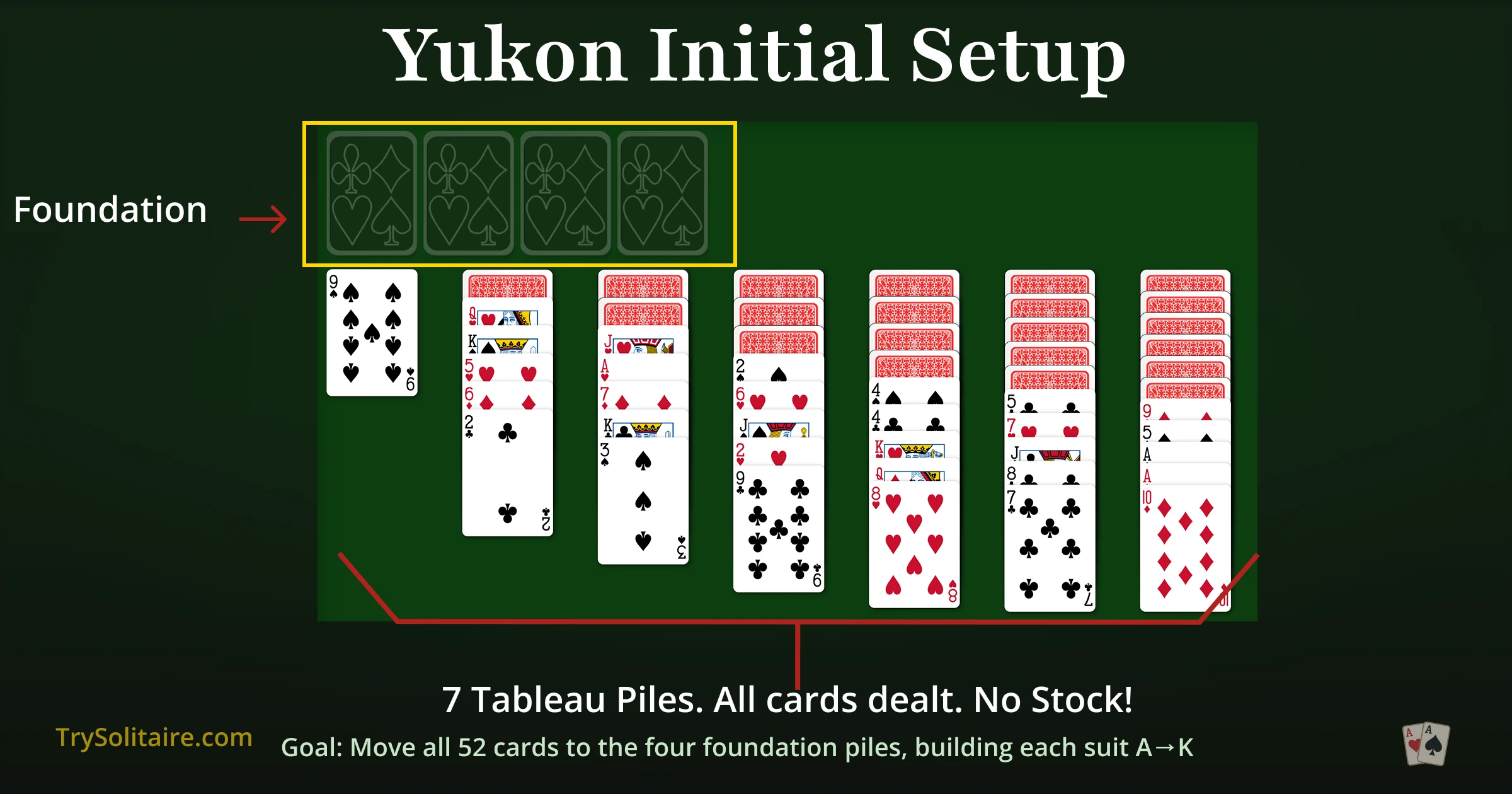
- Tableau: seven columns. The first column has 1 card, the second 6, the third 7, and so on up to 11 in the seventh. The top five cards of each column (after the first) are face-up — but in this version all cards are face-up from the start.
- No stock, no waste. Everything you'll use is on the table from the first move.
- Foundations: four empty piles, top right. Build up by suit, Ace to King.
Rules
- Build tableau columns down by alternating color. A black 9 goes on a red 10.
- Move any face-up card with everything beneath it as a single group, regardless of order. This is the defining Yukon rule. The card you pick must be a legal placement on the destination, but the cards beneath it don't need to be in sequence.
- Only Kings (or any group with a King at the bottom) can fill an empty column.
- Foundations build up by suit, Ace to King. You can move a card back from a foundation to the tableau if needed.
Yukon vs Klondike
Same family, different rules. Yukon is harder by some metrics, easier by others.
| Aspect | Klondike | Yukon |
|---|---|---|
| Tableau columns | 7 | 7 |
| Stock pile | 24 cards | None |
| Hidden cards | 21 face-down | None |
| Group moves | Only properly ordered alternating-color sequences | Any face-up card plus everything beneath it |
| Empty columns | King only | King only |
| Practical win rate (skilled) | ~40% Draw 1 | ~75–80% |
The all-face-up start removes Klondike's hidden information. The lift-anything rule gives you huge mobility but also more decisions. Most players win Yukon more often than Klondike Draw 1.
What's the Best Yukon Strategy?
- Plan before you move. Every card is visible. Trace the chain you want to build before committing to the first move.
- Empty a column early. Empty columns are the most powerful tool for re-arranging chains. Aim to clear at least one column in the first few moves.
- Save Aces and 2s for when they help. Sending an Ace to the foundation is final. Hold off if the Ace is sitting on top of a card you need to move first.
- Watch the Kings. Only Kings fill empty columns. If all four Kings are buried at the bottom of long stacks, the empty-column game is over.
- Move groups, not single cards. The any-card-with-everything-beneath rule is Yukon's superpower. A long messy stack on top of a target card can be moved as one unit if the top card is a legal placement.
- Foundation timing. Don't rush 4s, 5s, 6s up. Mid-rank cards are useful for building tableau sequences and worth keeping in play longer than corner ranks.
A Short History
Yukon dates to the same Yukon Klondike Gold Rush era (1896–1899) as its more famous sibling. The name reflects the place rather than a specific person. The all-face-up, no-stock variant has been documented in patience anthologies since the early 20th century. Microsoft included Yukon in Microsoft Entertainment Pack 4 (1992) but didn't add it to the Solitaire Collection that ships with modern Windows.
About This Version
This Yukon runs in your browser — free, no download, no sign-up. Install as an app on your phone or computer; once installed it works offline. Unlimited undo, statistics, and a daily challenge that gives every player the same deal that day so you can compare times.
Other Solitaire Games to Try
- Klondike — the seven-column classic with a stock pile
- Spider — two decks, ten columns, suit-based sequences
- FreeCell — every card visible, four free cells for temporary storage
- Scorpion — Spider's harder cousin, no stock pile either
For deeper strategy and the full history of Yukon, see our Yukon guide.