How to Play Solitaire: The Complete Beginner's Guide
Master the classic card game with our step-by-step guide for absolute beginners
Last Updated: August 2026 | Reading Time: 10 minutes
Quick Start: Solitaire is a single-player card game where you arrange a 52-card deck into four foundation piles by suit, from Ace to King. This guide walks you through how to set up Solitaire from scratch, the full rules, and the beginner strategies that actually work — jump to the setup section if you just want to start playing.
What is Solitaire?
Solitaire (also called Patience or Klondike) is the world's most popular single-player card game. Played with a standard 52-card deck, the goal is to arrange all cards into four foundation piles—one for each suit—organized from Ace to King.
The game became a household name when Microsoft included it with Windows 3.0 in 1990 — written by intern Wes Cherry, with card faces designed by Susan Kare. By 1994 Microsoft itself acknowledged that Solitaire had become the most-used application on Windows. Today the Microsoft Solitaire Collection reports tens of millions of monthly active players. Ready to try it? Play Solitaire free online →
Did You Know? The term "Solitaire" comes from the French word for "alone" or "solitary." In the UK and other countries, it's often called "Patience."
What You Need to Play
- One standard 52-card deck (no jokers)
- A flat playing surface (table or play online)
- 5-15 minutes for an average game
- Basic understanding of card ranks and suits
That's it! Solitaire is one of the simplest games to set up, which is part of why it's so popular.
How to Set Up Solitaire: Step-by-Step
Step 1: Shuffle the Deck
Thoroughly shuffle your 52-card deck to randomize the cards. Good shuffling ensures each game is different and challenging.
Step 2: Deal the Tableau (The Main Playing Area)
Create seven columns of cards, dealt from left to right:
- Column 1: 1 card (face-up)
- Column 2: 2 cards (top card face-up, 1 face-down)
- Column 3: 3 cards (top card face-up, 2 face-down)
- Column 4: 4 cards (top card face-up, 3 face-down)
- Column 5: 5 cards (top card face-up, 4 face-down)
- Column 6: 6 cards (top card face-up, 5 face-down)
- Column 7: 7 cards (top card face-up, 6 face-down)
This uses 28 cards total (1+2+3+4+5+6+7 = 28).
Step 3: Place the Stock Pile
The remaining 24 cards become your "stock" pile. Place them face-down in the upper-left corner of your playing area.
Step 4: Create Space for Foundations
Leave room for four foundation piles in the upper-right area. These start empty and will eventually hold all 52 cards organized by suit.
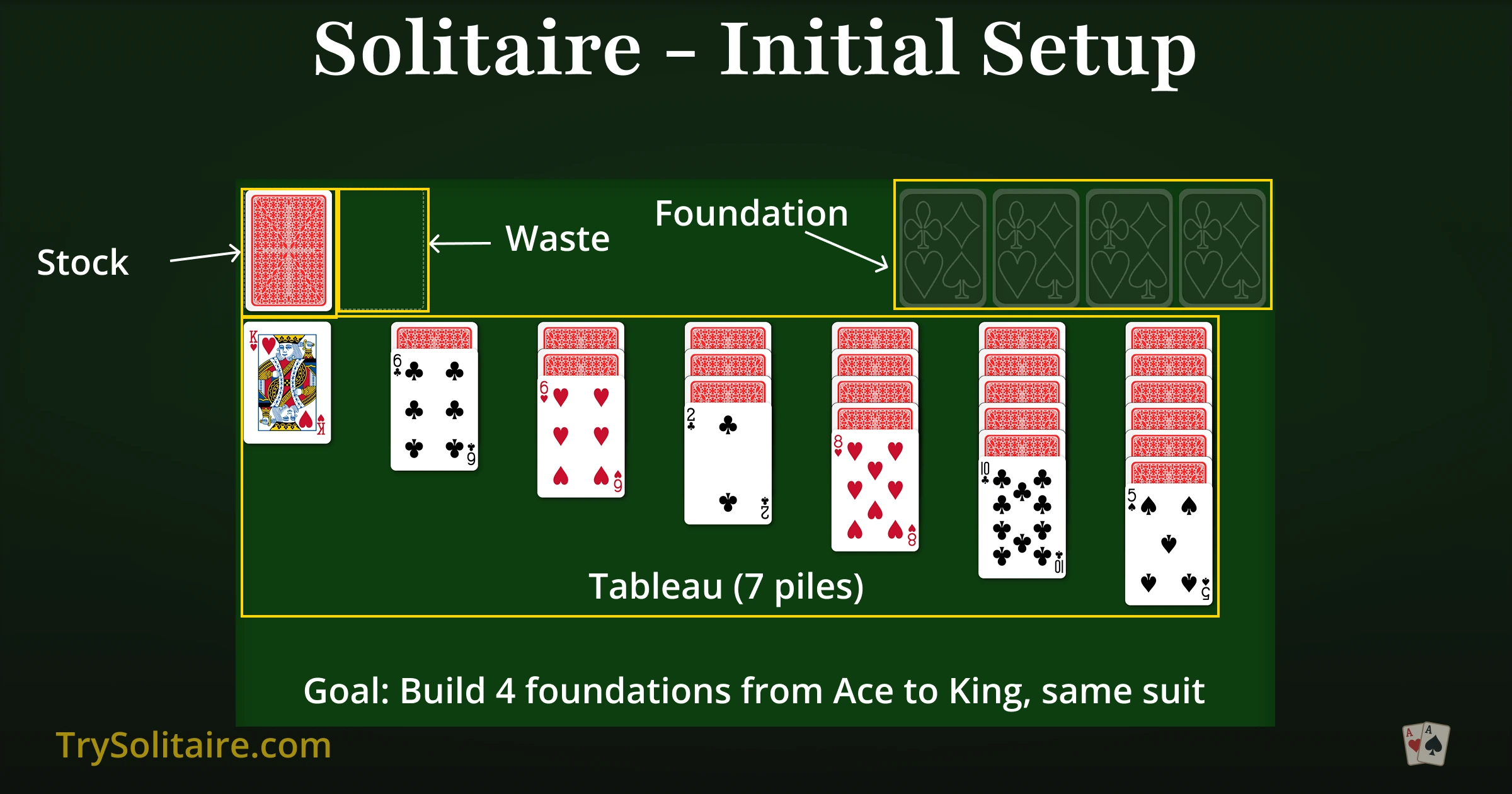
Visual Layout: The complete setup is shown below with all areas labeled—7 tableau columns in the middle, stock pile (upper-left), 4 empty foundations (upper-right), and waste pile next to the stock.
How to Play: The Rules
Objective
Move all 52 cards to the four foundation piles, building each suit from Ace through King.
Basic Rules
Building in the Tableau (The 7 Columns)
- Descending Order: Cards must be placed in descending rank (King, Queen, Jack, 10, 9, 8, 7, 6, 5, 4, 3, 2, Ace)
- Alternating Colors: Red cards go on black cards, black cards go on red cards
- Example: A red 6 can go on a black 7
- Example: A black Queen can go on a red King
- Moving Sequences: You can move multiple cards together if they form a valid sequence
- Kings Only: Only Kings can be placed in empty columns
- Revealing Cards: When you move a face-up card, flip the card beneath it face-up
Building the Foundations
- Start with Aces: Each foundation must start with an Ace
- Build by Suit: Each foundation contains only one suit
- Ascending Order: Build up from Ace → 2 → 3 → 4... → Jack → Queen → King
- Flexible Movement: You can move cards back from foundations to tableau if needed (with a -10 score penalty)
Using the Stock Pile
- Draw 1 or Draw 3: Most Solitaire games let you draw 1 or 3 cards at a time from stock
- Draw 1: Easier for beginners (higher win rate)
- Draw 3: Traditional challenge (lower win rate, more strategy)
- Waste Pile: Cards from stock go to the waste pile face-up
- Only Top Card: Only the top card of the waste pile can be played
- Unlimited Passes: In most versions, you can go through the stock pile multiple times
Want to Win More Often?
Once you have the rules down, the strategy that actually moves your win rate is straightforward: reveal face-down cards before doing anything else, don't rush mid-rank cards (4–10) to foundations, and treat empty columns as a precious resource rather than a slot to fill. The full strategy treatment — including six concrete principles, common mistakes that quietly kill win rates, and how to plan multiple moves ahead — lives in How to win at solitaire.
Built-in Solver: Check If Your Game Is Winnable
Here's something most solitaire players don't know: about 21% of Klondike Draw 1 games are mathematically impossible to win, no matter how well you play. In Draw 3 mode, that number jumps to about 70%. You could be playing a game perfectly and still lose — simply because the deal had no solution from the start.
TrySolitaire solves this problem with a built-in solitaire solver that runs right in your browser. The solver analyzes your game position in real time and tells you whether a winning path exists.
How It Works
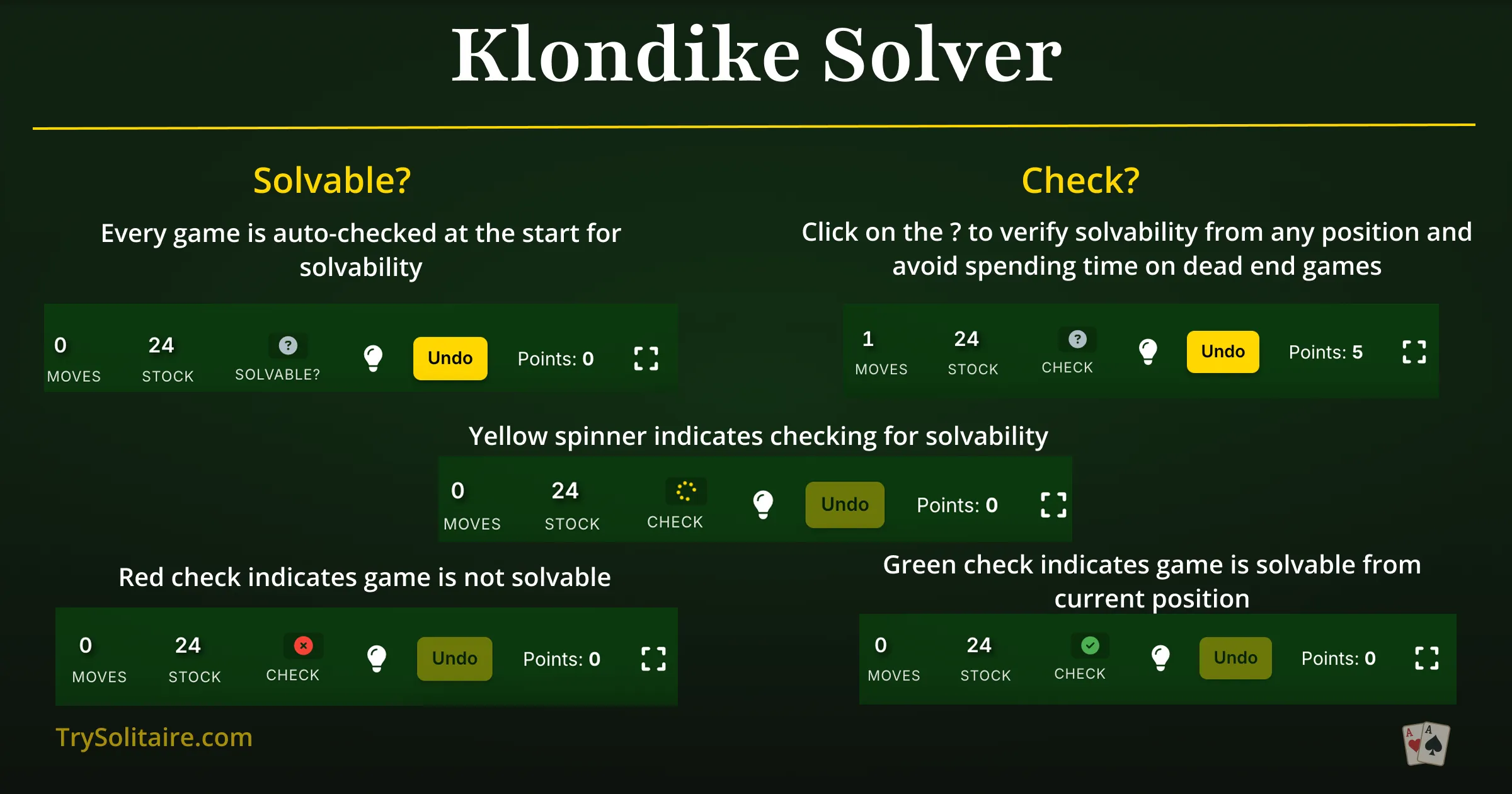
Look for the solver status icon in the game toolbar while you play:
- Green Checkmark — Your game is winnable. A solution exists if you find the right moves.
- Red X — No winning path exists from your current position. Click for recovery options.
- Gold Spinner — The solver is analyzing your position (usually takes a few seconds).
- Gray Question Mark — Not yet checked. Click to trigger an analysis.
Key Solver Features for Beginners
Deal Winnable Game
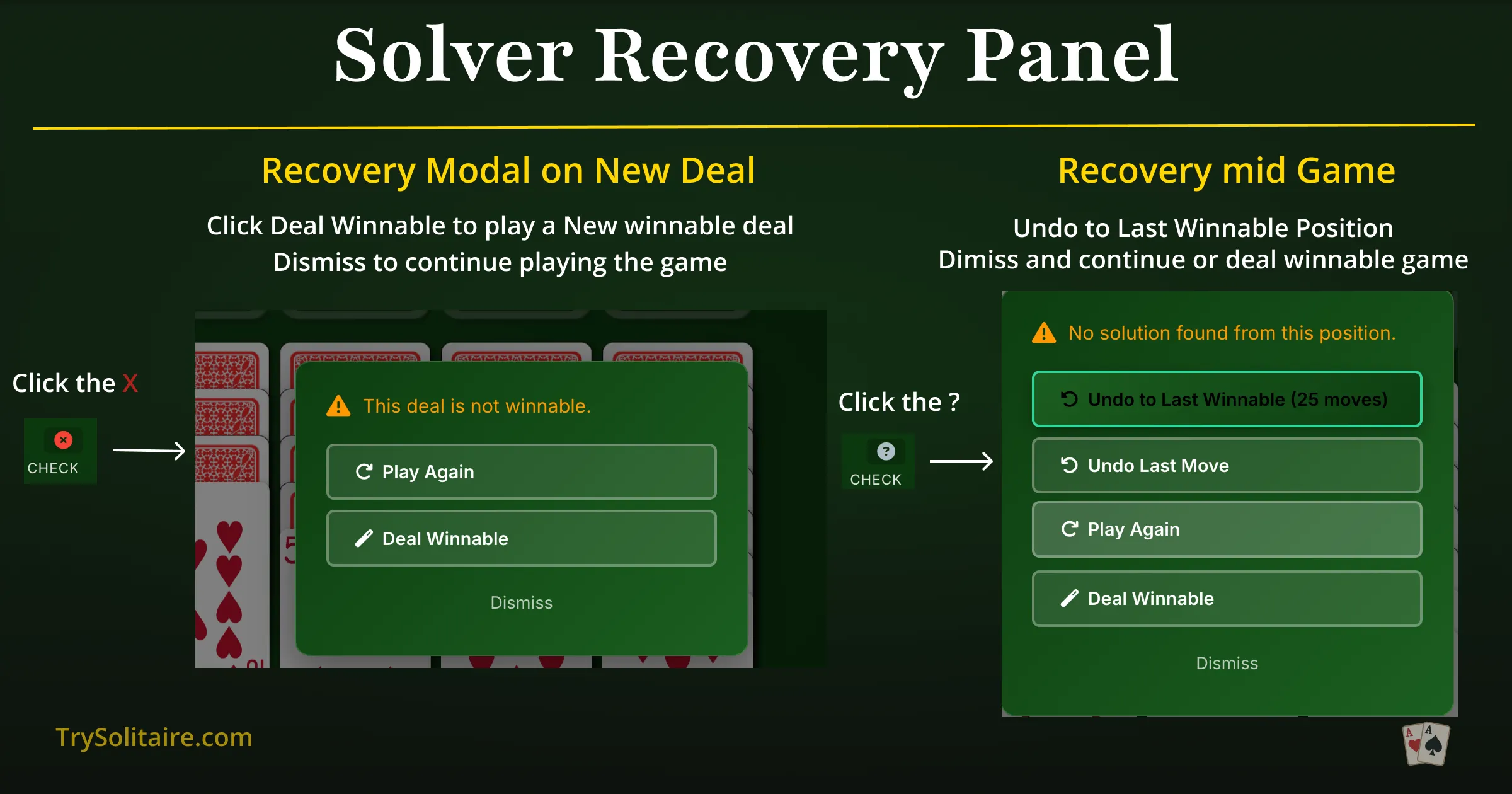
Use the "Deal Winnable" option in the new game menu to start with a deal that's guaranteed to have a winning path. This is perfect for beginners who want to focus on learning strategy without the frustration of impossible games.
Undo to Winnable
Made a move that killed your chances? When the solver detects your game has become unsolvable, it offers to automatically undo back to the last winnable position. This lets you learn from mistakes and try a different strategy without starting over.
Beginner Tip: Start with "Deal Winnable" games in Draw 1 mode. This way, every game you play is solvable — when you lose, you know it's a strategy opportunity, not bad luck. As your skills improve, try regular deals and use the solver to check your position when you feel stuck.
Want to dive deeper? Read our complete Solitaire Solver guide or learn how to tell if your solitaire game is winnable.
Popular Solitaire Variations
Once you master Klondike Solitaire (the standard version), try these popular variants:
| Game | Difficulty | Key Difference |
|---|---|---|
| Spider Solitaire (Guide) | Hard | Uses 2 decks, build descending sequences of same suit |
| FreeCell (Rules) | Medium | All cards visible, 99.99% winnable with skill |
| TriPeaks (Guide) | Easy | Clear three pyramid peaks, fast-paced gameplay |
| Golf Solitaire (Guide) | Easy | Build sequences ±1 rank, quick 3-5 minute games |
| Pyramid Solitaire (Guide) | Medium | Pair cards that sum to 13 |
Frequently Asked Questions
Is Solitaire hard to learn?
No! Solitaire is one of the easiest card games to learn. The basic rules can be understood in 5 minutes, though mastering winning strategies takes practice. Most beginners can play their first complete game within 10 minutes of learning.
What percentage of Solitaire games are winnable?
With perfect play, approximately 80% of Klondike Solitaire games are theoretically winnable. However, average players win about 10-30% of games. With practice and strategy, skilled players can achieve 40-50% win rates.
Should I play Draw 1 or Draw 3?
Beginners should start with Draw 1 (drawing one card at a time from the stock). This gives you more control and higher win rates. Draw 3 is the traditional challenge mode—try it once you're comfortable with the basic game.
Can I move cards back from the foundations?
Yes, you can drag cards back from foundations to the tableau, but doing so incurs a -10 score penalty. This gives you strategic flexibility if you realize you need a card back on the tableau. Alternatively, you can use the Undo button to reverse moves without any penalty.
How long does a typical Solitaire game take?
Most games take 5-15 minutes. Quick wins might take 3-5 minutes, while difficult games can take 20+ minutes as you carefully plan moves and cycle through the stock pile multiple times.
Is online Solitaire the same as playing with real cards?
Yes, the rules are identical! Online Solitaire offers advantages like automatic card movement, undo features, hints, and statistics tracking. The core gameplay and strategy remain the same.
Why is Solitaire so popular?
Solitaire is popular because it's easy to learn, requires no other players, can be played in short bursts, provides mental stimulation, and offers a perfect balance of luck and skill. It's also free, widely available, and deeply satisfying when you win.
How do I know if my solitaire game is winnable?
TrySolitaire has a built-in solver that checks if your game is winnable in real time. The solver icon in the toolbar shows a green checkmark (winnable), red X (unsolvable), or gold spinner (analyzing). You can also use the "Deal Winnable" feature to start with a guaranteed-solvable hand. Learn more about the solver →
Are all solitaire games winnable?
No. About 21% of Klondike Draw 1 games and 70% of Draw 3 games are mathematically impossible to win regardless of strategy. TrySolitaire's solver identifies these unwinnable deals so you don't waste time on them. Use the "Deal Winnable" option to always start with a solvable game. Learn about solitaire winnability →
Ready to Play?
Now that you know how to play Solitaire, you're ready to start! Try our free online version with no downloads or signup required. Choose from multiple game variants, track your statistics, and improve your skills.
Playing with an older parent or grandparent? See our guide to solitaire for seniors, or the step-by-step setup guide for elderly parents.
🎯 Strategy & Tips:
- How to win at solitaire — strategy principles, common mistakes, and what actually moves the win rate
📚 Game Guides:
- Klondike Solitaire - Advanced strategies for the classic game
- Spider Solitaire - Master the challenging 2-deck variant
- FreeCell Solitaire — win 99% of games with skill, all cards face-up
- Pyramid Solitaire - Pair matching fun
- TriPeaks Solitaire - Fast-paced peak clearing
🔍 Solver & Winnability:
- Solitaire Solver Guide - Check if your game is winnable
- Is My Game Winnable? - Understanding solitaire solvability
📖 Learn More:
- Hardest solitaire games, ranked — win rates & skill levels
- Popular Solitaire Variants - Explore 16+ games
- The History of Solitaire - From origins to today