Patience: The Classic British Card Game
Last updated: November 15, 2025
Patience is the quintessential British card game that has been a beloved pastime for over a century. Known to Americans as "Klondike" or simply "Solitaire", Patience represents a cherished tradition of British gaming culture, popularised during the Victorian era and enjoyed by millions ever since. Whether you remember playing with your grandmother's well-worn deck of cards or discovered it through digital versions, Patience remains Britain's favourite single-player card game.
What makes Patience special? Unlike games of pure chance, Patience rewards strategic thinking, careful planning, and patient persistence—qualities that gave the game its fitting name. Research demonstrates that 79% of Patience Turn 1 games are theoretically winnable with perfect play, meaning your decisions genuinely matter. Available in two main variants—Turn 1 (easier, drawing one card at a time) and Turn 3 (harder, drawing three cards at a time)—Patience offers the perfect challenge whether you're a beginner or an experienced player.
At TrySolitaire, you can play Patience completely free with no adverts, no sign-up required, and full offline support. Enjoy unlimited undo, customisable card styles (including traditional British designs), statistics tracking, and both Turn 1 and Turn 3 modes. Whether you have 5 minutes during your tea break or an hour on a rainy afternoon, Patience is always ready for a brilliant mental challenge.
🇬🇧 British Heritage: Patience vs Solitaire
Did you know? What British people call "Patience" is exactly the same game Americans call "Klondike" or "Solitaire". The name "Patience" has been used in Britain since the Victorian era, derived from French card games known as "patiences". Meanwhile, North Americans adopted the name "Klondike" from the Canadian gold rush of the 1890s. Same beloved game, different names across the pond!
This guide uses traditional British terminology throughout: "colour" instead of "color", "organise" instead of "organize", and "practise" (verb) instead of "practice". We're proud to honour the British heritage of this classic game.
Quick Start Guide: Play Patience in 30 Seconds
Never played Patience before? No worries! Here's how to start playing straight away:
- Understand the Goal: Move all 52 cards to the four foundation piles (top right), building each suit from Ace to King.
- Learn Tableau Moves: In the seven tableau columns, stack cards in descending order with alternating colours—red on black, black on red (e.g., red 7 on black 8).
- Draw from the Stock: Click the stock pile (top left) to reveal new cards. In Turn 1 mode, you draw one card; in Turn 3 mode, you draw three cards at a time.
- Start with Aces: Always move Aces to the foundations immediately—they're the foundation of each pile and have no downside to moving early.
- Expose Hidden Cards: Prioritise moves that flip face-down cards in the tableau, as revealing new cards gives you more options and opportunities.
That's it! Click the "Play Now" button above and you'll be playing Patience within seconds. The intuitive drag-and-drop interface makes it easy to move cards, and the unlimited undo button means you can experiment with different strategies without pressure. Perfect for learning the game at your own pace.
What is Patience? Britain's Favourite Card Game
Patience is a single-player card game played with a standard 52-card deck, where the objective is to build four foundation piles from Ace to King, organised by suit. The game has been a cornerstone of British gaming culture since the Victorian era, providing entertainment and mental stimulation for generations of players across the solitaire family.
The Name "Patience" Explained
The game earned its name from the careful, methodical approach required to win. Unlike games of pure luck, Patience demands patience (as the name suggests), strategic thinking, and the ability to plan several moves ahead. The term comes from French card games known as "réussites" or "patiences" that became fashionable in Britain during the 1800s.
Patience vs Solitaire vs Klondike
These three names refer to the same game, with regional preferences:
- Patience: Traditional British and Commonwealth term, used since the Victorian era
- Solitaire: American term for the family of single-player card games
- Klondike: North American name for this specific variant, from the 1890s Canadian gold rush
Whilst Americans might search for "Klondike Solitaire", British players recognise this as simply "Patience"—the game that's been played in British homes, pubs, and parlours for over a century. At TrySolitaire, we honour both traditions, making the game accessible regardless of what you call it.
A Proper British Card Game
Patience holds a special place in British culture. It's the game you might have learnt from your grandparents on a rainy Sunday afternoon, played during tea breaks at work, or enjoyed whilst commuting on the train. The game appeared in countless British card game books from the Victorian and Edwardian eras, cementing its status as a national pastime. Even today, Patience remains one of the most-played games in Britain, with thousands searching for "patience card game" every month.
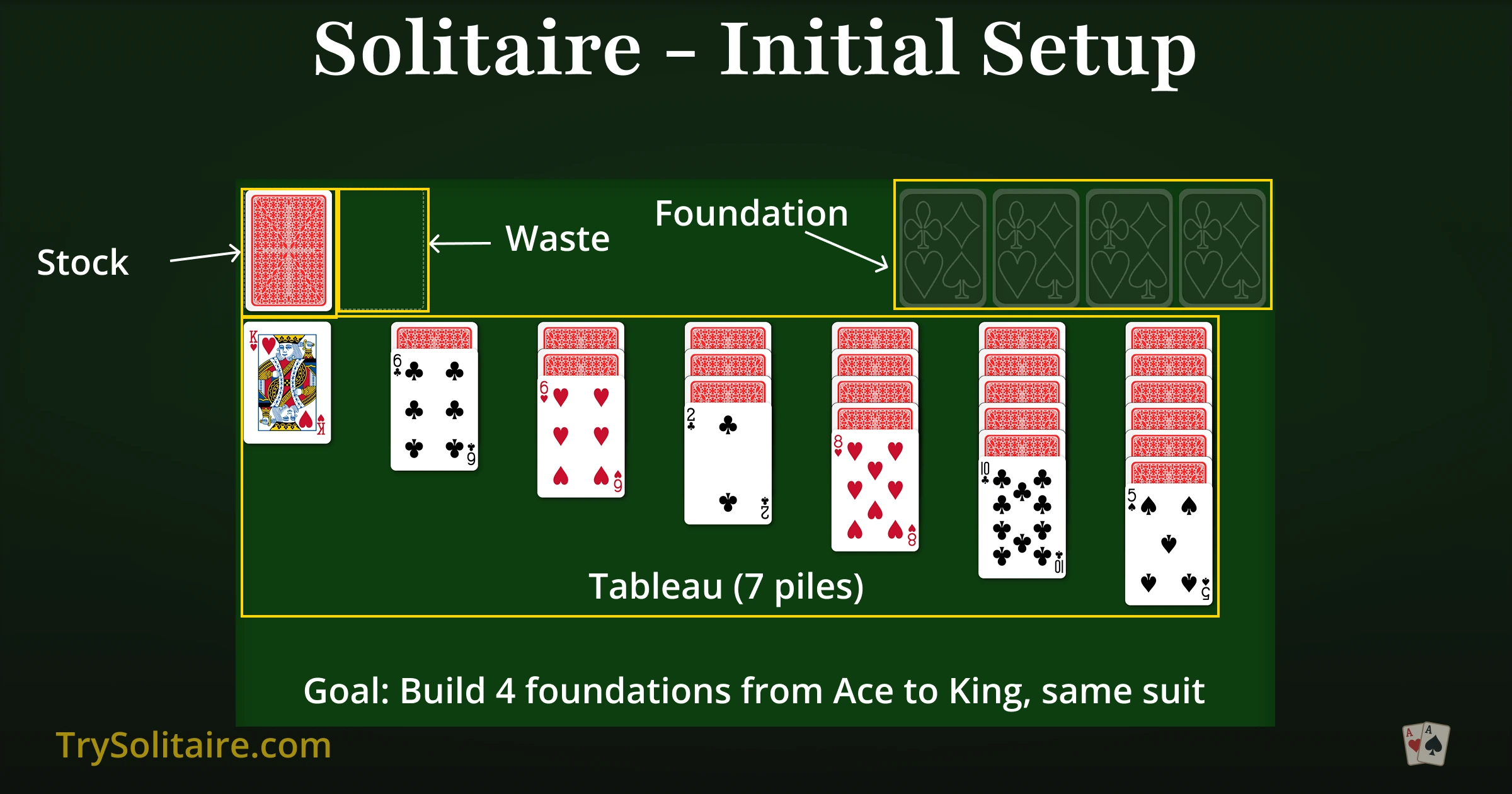
Standard Patience layout: 7 tableau columns (1-7 cards each), 4 empty foundations, stock pile, and empty waste pile
How to Play Patience: Complete Rules
Patience is played with a standard 52-card deck containing four suits (Hearts, Diamonds, Clubs, Spades) with 13 ranks each (Ace through King). The game area consists of four distinct zones, each serving a specific purpose:
Game Layout and Card Areas
- Tableau (7 columns): The main playing area with seven columns of cards. The first column has 1 card, the second has 2 cards, continuing up to 7 cards in the seventh column. Only the top card in each column starts face-up, with all other cards face-down. This is where most of your strategic manoeuvring happens.
- Foundations (4 piles): Located in the top-right corner, these four empty spaces are where you build your winning piles. Each foundation represents one suit (Hearts, Diamonds, Clubs, Spades) and must be built sequentially from Ace to King.
- Stock Pile: The face-down deck in the top-left corner containing the remaining 24 cards not dealt to the tableau. Click this pile to draw new cards into the waste pile.
- Waste Pile: Located next to the stock pile, this is where drawn cards are placed face-up. The top card of the waste pile is always available for play.
Objective
The goal of Patience is to move all 52 cards to the four foundation piles, building each foundation from Ace to King in the same suit. You win when all four foundations are complete (Ace through King in Hearts, Diamonds, Clubs, and Spades). It's a brilliant feeling of accomplishment!
Legal Moves in Patience
Understanding what moves are allowed is crucial to mastering Patience. Here are the complete rules for moving cards:
Moving Cards to Foundations:
- Foundations must start with an Ace and build upward in the same suit: A → 2 → 3 → 4 → 5 → 6 → 7 → 8 → 9 → 10 → J → Q → K
- You can move cards to foundations from the tableau, waste pile, or even from other foundations (though this is rarely beneficial)
- Only one card can be moved to a foundation at a time—you cannot move sequences
- Example: If the Hearts foundation shows a 5♥, you can only place the 6♥ on it next
Foundation building in Patience: Each suit must progress from Ace to King in sequential order
Moving Cards in the Tableau:
- Cards must be placed in descending rank order (King, Queen, Jack, 10, 9, 8, 7, 6, 5, 4, 3, 2)
- Cards must alternate colours: red cards (Hearts, Diamonds) must be placed on black cards (Clubs, Spades), and vice versa
- You can move single cards or entire sequences of cards that follow the alternating colour and descending rank pattern
- Example: A black 8 can be placed on a red 9, then a red 7 on that black 8, then a black 6 on the red 7—this entire sequence (8-7-6) can be moved together as a unit
- Only Kings (or sequences starting with Kings) can be placed on empty tableau columns
- When you move a face-up card and reveal a face-down card beneath it, the face-down card automatically flips face-up
Valid tableau moves in Patience: Red on black, black on red, always descending in rank
Drawing from the Stock Pile:
- Turn 1 Mode: Click the stock to draw one card at a time into the waste pile. The drawn card is immediately available for play.
- Turn 3 Mode: Click the stock to draw three cards at a time. Only the top card of the three is playable; you must use it before accessing the cards beneath.
- When the stock is empty, click the empty space to recycle the waste pile back into the stock and continue drawing
- TrySolitaire allows unlimited recycling in both modes, giving you maximum strategic flexibility
Winning and Losing
You win when all 52 cards have been successfully moved to the four foundations, with each foundation showing a complete sequence from Ace to King in one suit. Absolutely brilliant!
You lose when no legal moves remain and you cannot progress further towards victory. This happens when all tableau columns are blocked, the stock has been fully cycled, and no cards can be moved to foundations or between tableau columns. In TrySolitaire, you can use the unlimited undo feature to try different move sequences and avoid premature losses.
Turn 1 vs Turn 3 Patience: Which Should You Play?
Patience comes in two main variants that differ in difficulty based on how you draw cards from the stock pile. Understanding the difference helps you choose the right challenge for your skill level and mood.
Turn 1 Patience
Difficulty: Medium
Draw Style: One card at a time
Best For: Learning, strategic play, maximising wins
Turn 1 Patience draws one card at a time from the stock pile, making every card accessible when you need it. This variant offers the highest win rate (79% with perfect play) and rewards careful planning. Ideal for players who want to focus on strategy rather than luck. The traditional British way to play!
Turn 3 Patience
Difficulty: Hard
Draw Style: Three cards at a time
Best For: Challenge seekers, experienced players, quick games
Turn 3 Patience draws three cards at a time with only the top card playable. This classic variant is significantly harder (only 30% winnable) as many cards become temporarily trapped. A proper challenge that tests both skill and patience—the name is well deserved!
Which variant should you choose? If you're new to Patience or want to maximise your win rate whilst learning advanced strategies, start with Turn 1. It's the perfect training ground for understanding optimal play patterns. Once you're consistently winning Turn 1 games, challenge yourself with Turn 3 for a true test of strategic foresight and adaptability. Many expert players enjoy both variants for different reasons: Turn 1 for satisfying strategic depth, and Turn 3 for its unforgiving challenge.
Both variants are available instantly at TrySolitaire—just select your preferred mode from the settings menu before starting a new game. No registration, no adverts, just straightforward Patience whenever you want it.
Visual comparison: Turn 1 draws one card (easier), Turn 3 draws three cards with only the top card playable (harder)
Patience Strategy Guide: Win More Games
Whilst Patience involves some luck in the initial deal, expert players can achieve win rates of 40-50% in Turn 1 mode by following proven strategies. Here are the essential strategic principles that separate casual players from Patience masters:
Essential Patience Strategies
- Always Move Aces and 2s to Foundations Immediately: Unlike higher-ranked cards, Aces and 2s have no strategic value in the tableau. Moving them to foundations creates space and reduces clutter without any downside. Don't hesitate—get them out of the way straight away.
- Expose Face-Down Cards First: The single most important strategic principle in Patience is revealing hidden cards. Every face-down card you flip gives you more information and more options. When choosing between two moves, always prefer the one that flips a new card, even if the alternative seems more immediately beneficial.
- Build Tableau Columns Evenly: Avoid building one or two columns extremely high whilst leaving others short. Balanced columns give you more flexibility and movement options. If one column has 10 cards whilst others have 2-3, you've likely made suboptimal moves.
- Empty Columns Are Powerful—Use Them Wisely: Empty tableau columns are incredibly valuable because only Kings can fill them. Before creating an empty column, ensure you have a King (or a good chance of revealing one) to place there. An empty column can serve as a temporary holding area for sequences, enabling complex multi-move combinations.
- Don't Rush Cards to Foundations: Whilst it's tempting to move every possible card to the foundations, sometimes you need low-ranked cards (3s, 4s, 5s) to build tableau sequences. Before moving a card to a foundation, ask yourself: "Will I need this card in the tableau soon?" This is especially important for cards in the 3-7 range.
- Prioritise Moves That Create More Moves: Think one or two steps ahead. The best moves aren't just legal—they're moves that enable additional moves afterwards. For example, moving a card that allows you to flip a face-down card is better than a move that simply changes the tableau arrangement.
- Cycle Through the Stock Strategically: In Turn 1, you can cycle through the stock multiple times to find the exact card you need. In Turn 3, timing is crucial—sometimes you should delay cycling through the stock until you've exhausted all tableau moves, as cycling might bury a currently accessible card you need.
- Learn to Recognise Dead Ends Early: Some deals simply aren't winnable. If you've cycled through the stock 2-3 times and made no progress, the deal might be impossible. Recognising unwinnable situations saves time and frustration—don't be afraid to start a new game and try your luck again.
- Use the Undo Button Liberally: TrySolitaire's unlimited undo feature lets you experiment with different move sequences without penalty. Found yourself in a dead end? Undo 10 moves and try a different approach. This trial-and-error process is how you develop intuition for optimal play.
- Master Turn 1 Before Attempting Turn 3: Turn 3 Patience requires all the Turn 1 strategies plus additional foresight about stock cycling. Build your strategic foundation with Turn 1, then graduate to Turn 3 when you're consistently winning 30-40% of Turn 1 games.
Advanced Strategic Concepts
Sequence Preservation: When you have a choice between breaking up a long alternating sequence or keeping it intact, preservation is often better. A sequence like K-Q-J-10-9-8-7 can be moved as a unit, giving you incredible flexibility. Breaking it apart means you'll need to rebuild it later, wasting valuable moves.
King Placement Timing: Since Kings can only go in empty columns, placing a King is a significant commitment. Wait until you've revealed several face-down cards and have a clearer picture of the game state before committing Kings to empty columns. A poorly placed King can block crucial moves later in the game.
Foundation Return Strategy: Advanced players sometimes move cards from foundations back to the tableau when a low-ranked card is needed to continue a sequence. For example, if you have a 4 in the foundation but need it to place a 3 on, moving it back can unlock the game. Use this technique sparingly and strategically.
Colour Distribution Awareness: Pay attention to whether you have roughly equal numbers of red and black cards available. If your tableau is all red cards, you can only make moves when black cards appear from the stock. Balanced colour distribution maintains flexibility and creates more opportunities.
By internalising these strategies and practising regularly, you'll see your Patience win rate climb steadily. Remember: every game is a learning opportunity, even the losses! The beauty of Patience is that it rewards thoughtful play whilst still offering the unpredictability that makes each game unique. Looking for different challenges? Try Spider Solitaire for a two-deck strategic challenge, or FreeCell where 99% of games are winnable with perfect play.
Patience Win Rates and Statistics
One of the fascinating aspects of Patience is how the game balances skill and luck. Understanding the statistics behind Patience helps set realistic expectations and appreciate the skill ceiling of this classic British game.
Theoretical Win Rate: Turn 1 Patience
of games are theoretically winnable with perfect play
According to extensive computer simulations and mathematical analysis, approximately 79% of Patience Turn 1 deals have at least one winning solution. This means that in roughly 4 out of 5 games, the initial card distribution allows for victory if you make all the optimal moves. The remaining 21% of games are mathematically impossible to win regardless of strategy.
However, achieving a 79% win rate requires perfect play—knowing the optimal move at every decision point. In reality, even expert human players typically achieve win rates of:
- Beginner Players: 5-10% win rate (1 in 10-20 games)
- Intermediate Players: 15-20% win rate (1 in 5-7 games)
- Advanced Players: 25-35% win rate (1 in 3-4 games)
- Expert Players: 40-50% win rate (1 in 2-2.5 games)
The gap between the theoretical 79% and even expert players' ~50% win rate reveals Patience's hidden depth. Many games have only one or two winning paths amongst dozens of possible move sequences, making it challenging to find the optimal route without computer-level calculation. This is precisely why the game is called "Patience"—it requires careful thought and persistence!
Turn 3 Patience Statistics
Turn 3 Patience (drawing three cards at a time) is significantly more difficult:
Theoretical Win Rate: Turn 3 Patience
of games are winnable with perfect play
Only about 30% of Turn 3 deals are solvable, and typical player win rates range from 1-5% for beginners to 10-15% for experts. The three-card draw mechanic dramatically reduces available options, making many cards temporarily inaccessible. This variant truly tests your patience and strategic foresight!
Game Duration Statistics
- Average Winning Game: 8-12 minutes (casual pace), 2-4 minutes (expert pace)
- World Record Speed: Under 30 seconds for extremely favourable deals with perfect execution
- Average Game (Including Losses): 5-8 minutes, as unwinnable games are often abandoned early
- Perfect for Tea Breaks: A game of Patience fits brilliantly into a 10-minute break at work or home
Move Statistics
- Minimum Moves to Win: Theoretically as few as 52 moves (one per card), but practically 80-150 moves
- Average Winning Game: 120-180 moves including stock draws and repositioning
- Stock Cycles: Winning games typically cycle through the stock 2-5 times in Turn 1, 3-8 times in Turn 3
Track Your Statistics with TrySolitaire
TrySolitaire automatically tracks your Patience statistics including:
- Games played and games won
- Current win streak and best win streak
- Best completion time
- Overall win rate percentage
Watching your win rate improve over time is one of the most satisfying aspects of playing Patience. As you internalise the strategies above, you'll see measurable progress in your statistics. It's brilliant motivation to keep practising and refining your technique!
History of Patience in Britain
Patience has been an integral part of British gaming culture for over 150 years, with roots stretching back to the Victorian era. The game's journey from French parlours to British homes tells a fascinating story of cultural adoption and enduring popularity.
Victorian Era Origins (1870s-1900s)
Patience games arrived in Britain during the Victorian period, imported from France where they were known as "réussites" (successes) or "patiences". The term "patience" was particularly apt for British sensibilities, emphasising the careful, methodical approach required to win. Early British card game books from the 1870s and 1880s documented dozens of patience variants, cementing the games' place in British culture.
The Victorian era's emphasis on self-improvement and mental discipline made patience games particularly fashionable. Unlike gambling card games, patience was seen as a respectable pastime suitable for all ages and classes. Ladies and gentlemen alike could enjoy a game of patience during quiet afternoon hours, making it a staple of British parlour entertainment.
British Playing Card Traditions
Britain has a rich tradition of playing card manufacturing, with companies like Waddingtons (founded 1896) and De La Rue producing distinctive British-suited cards. Whilst most patience games use the French-suited cards (hearts, diamonds, clubs, spades) familiar today, the British connection to card games runs deep. Playing cards became more affordable and widely available during the late Victorian period, contributing to patience's growing popularity across all social classes.
Literary and Cultural References
Patience appears in numerous works of British literature from the late 19th and early 20th centuries. The game served as a metaphor for Victorian values: patience, persistence, and the belief that careful effort would eventually lead to success. British authors used patience scenes to depict characters in contemplation, passing time, or seeking solace during difficult moments.
The game became so embedded in British culture that "playing patience" became synonymous with methodical, solitary activity requiring concentration and care. This cultural association continues today, with patience remaining one of the most recognised and beloved British card games. Other British favourites include Canfield, which has casino origins, and Pyramid, a quick-playing matching game.
World War Era (1914-1945)
During both World Wars, patience games provided crucial entertainment and stress relief for British civilians and soldiers alike. The game's portability (requiring only a deck of cards) and single-player nature made it ideal for soldiers in trenches or civilians during air raids. Patience offered a mental escape and a sense of control during uncertain times.
Military personnel returning from the wars brought their patience skills home, further cementing the game's status as a British institution. Card game compendiums from this era often featured patience variants prominently, recognising the game's widespread popularity. Variants like Russian Solitaire and Scorpion also gained followings during this period.
Post-War Popularity (1950s-1980s)
The post-war decades saw patience remain a household staple across Britain. With television not yet universal and before the digital revolution, patience provided accessible entertainment requiring no special equipment beyond a standard deck of cards. British families typically owned at least one deck specifically for patience, often kept in a drawer ready for rainy afternoons or quiet evenings.
This era solidified patience as a multi-generational game, with grandparents teaching grandchildren the rules and strategies. The game became part of Britain's cultural heritage, passed down through families alongside other traditions.
Digital Revolution (1990s-Present)
The arrival of personal computers brought patience to new audiences. Microsoft's inclusion of "Solitaire" (the American term for patience/Klondike) in Windows introduced the game to millions worldwide, including many British users. However, older British players continued to refer to the game as "patience" despite Microsoft's American naming convention.
Today, patience enjoys renewed popularity through digital platforms like TrySolitaire, which combine traditional gameplay with modern conveniences: unlimited undo, statistics tracking, customisable card designs (including traditional British styles), and the ability to play on any device. The core game remains unchanged from Victorian times, but the experience has been enhanced for contemporary players. Modern players can also enjoy Golf Solitaire, TriPeaks, and even puzzle games like Sudoku and 2048 on the same platform.
Modern British Gaming Culture
In modern Britain, patience remains one of the most-played card games, with thousands of British players searching for "patience card game" every month. The game bridges generations, offering something familiar to older players who learnt with physical cards whilst attracting younger players through digital versions. Whether on a mobile during the morning commute, on a laptop during a work break, or with a traditional deck on a Sunday afternoon, patience continues its century-long tradition as Britain's favourite solitary card game.
The enduring popularity of patience speaks to the game's perfect balance of simplicity, strategy, and the very British quality of patient persistence. It's a game that rewards careful thought, doesn't rely solely on luck, and provides satisfying mental stimulation—qualities that have kept it beloved for over 150 years. Explore the broader history of solitaire games or discover Yukon, a challenging Patience variant with all cards visible from the start.
Patience vs American Solitaire: Same Game, Different Names
One of the most common questions British players ask is: "What's the difference between Patience and Solitaire?" The straightforward answer: they're exactly the same family of games, just with different regional names.
Terminology Comparison
| British Term | American Term | Notes |
|---|---|---|
| Patience | Solitaire | General term for single-player card games |
| Patience | Klondike | The specific game most people mean by "Patience" or "Solitaire" |
| Colour (red/black) | Color (red/black) | British vs American spelling |
| Practise (verb) | Practice (verb) | British vs American spelling |
| Favourite game | Favorite game | British vs American spelling |
Why Different Names?
British "Patience": Derived from French card games called "patiences" that became popular in Britain during the Victorian era. The name emphasises the careful, methodical approach required—you need patience to win!
American "Klondike": Named after the Klondike Gold Rush in Canada's Yukon Territory (1896-1899), where prospectors played this game during long winter months. Americans adopted "Klondike" as the specific name for this variant, whilst using "Solitaire" as the general term.
American "Solitaire": The general American term for all single-player card games, from French "solitaire" meaning "alone" or "solitary".
Same Rules, Same Game
Despite the different names, the rules are identical:
- Build foundations from Ace to King by suit
- Arrange tableau cards in descending order with alternating colours
- Draw from stock pile (Turn 1 or Turn 3)
- Win by completing all four foundation piles
Whether you call it Patience or Klondike, whether you spell it "colour" or "color", you're playing the same brilliant game that's entertained millions for over a century. At TrySolitaire, we respect both traditions and make the game accessible to players worldwide, regardless of what they call it.
If you'd like to read more about the North American perspective on this game, visit our Klondike Solitaire page which uses American terminology throughout. For more solitaire variants, explore Forty Thieves (two-deck challenge), Gaps (unique puzzle-style), or Accordion (extremely difficult). Looking for different types of games? Try Minesweeper for logic-based puzzles.
Frequently Asked Questions About Patience
What is the difference between Patience and Solitaire?
Patience and Solitaire are simply different names for the same family of card games. In Britain and Commonwealth countries, these games are traditionally called "Patience", whilst Americans typically use the term "Solitaire". The specific game most people know as Patience in the UK is called "Klondike" in North America. The name "Patience" reflects the game's requirement for careful thought and persistence, originating from the French word "patience". The rules are identical regardless of what you call it—same game, different regional terminology.
Why is it called Patience in the UK?
The game is called Patience in the UK because it derives from French card games known as "réussites" or "patiences", which became popular in Britain during the Victorian era. The name emphasises the careful, methodical approach required to win—you genuinely need patience to succeed! The term "Patience" has been used in Britain since at least the 1870s and appears in numerous British card game books from that period, cementing its status as the traditional British name. It remains the preferred British term today, whilst "Solitaire" or "Klondike" are more common in America.
How do you play Patience card game?
To play Patience, deal 28 cards into seven columns (1 card in the first column, 2 in the second, up to 7 in the seventh), with only the top card in each column face-up. The remaining 24 cards form the stock pile. Your goal is to build four foundation piles from Ace to King by suit. Move cards in the tableau in descending order with alternating colours (red on black, black on red). Draw cards from the stock pile one at a time (Turn 1, easier) or three at a time (Turn 3, harder). You win when all 52 cards have been moved to the four foundations in complete Ace-to-King sequences.
What percentage of Patience games are winnable?
In Patience Turn 1 (drawing one card at a time), approximately 79% of games are theoretically winnable with perfect play. However, the average player wins only 15-20% of games due to the difficulty of finding optimal move sequences. In Patience Turn 3 (drawing three cards at a time), the win rate drops to about 30% with perfect play, making it significantly more challenging. Even expert players rarely exceed 40-50% win rates in Turn 1. The gap between theoretical and practical win rates demonstrates why the game is called "Patience"—it truly requires careful thought and persistence!
Is Patience the same as Klondike?
Yes, what British people call Patience is exactly the same game that North Americans call Klondike. The name "Klondike" comes from the Canadian gold rush of the 1890s where the game became popular amongst prospectors during long winter months. When the game reached Britain, it was adopted under the traditional name "Patience" that had been used for similar card games since the Victorian era. Both names refer to identical rules: building foundations from Ace to King whilst manoeuvring cards in the tableau with alternating colours. TrySolitaire supports both names for the same beloved game, respecting British and American traditions alike.
Can you play Patience online for free?
Yes, you can play Patience completely free at TrySolitaire with no adverts, no sign-up required, and full offline support once loaded. The game includes both Turn 1 and Turn 3 variants, unlimited undo, customisable card styles (including traditional British designs), statistics tracking, and works brilliantly on mobile, tablet, and desktop devices. There are no hidden costs, no premium features behind paywalls, and no annoying adverts interrupting your game. Simply visit TrySolitaire and start playing immediately—it's as straightforward as that!
What's the best strategy for Patience?
The best Patience strategy involves several key principles: (1) Always move Aces and 2s to foundations immediately, (2) Prioritise moves that expose face-down cards in the tableau, (3) Keep tableau columns balanced rather than building one very high, (4) Create empty columns strategically for Kings, (5) Don't move cards to foundations too quickly if they might be needed for tableau building (particularly 3s through 7s), (6) Think several moves ahead before committing to a sequence, and (7) Use the undo button liberally to experiment with different approaches. Mastering these strategies through regular practise can increase your win rate from 10-15% to 40-50% over time. Patience truly rewards patient, thoughtful play!
How long does a game of Patience take?
A typical Patience game takes 5-15 minutes to complete for casual players, depending on thinking time and decision-making speed. Expert players can complete winning games in under 2-4 minutes by quickly recognising optimal moves and executing them efficiently. Games that end in defeat are often abandoned after 3-5 minutes when it becomes clear no winning moves remain. The game's duration makes it absolutely perfect for a tea break, a brief mental challenge during your commute, or a quiet moment at home. It's brilliant for those moments when you want something engaging but don't have hours to spare.
What cards do you need for Patience?
Patience requires a standard 52-card deck containing four suits (Hearts, Diamonds, Clubs, Spades) with 13 ranks each (Ace through King). You can use any traditional British or French-suited playing cards—brands like Waddingtons, Bicycle, or any standard deck work brilliantly. No jokers or special cards are needed. Online versions like TrySolitaire provide virtual cards with multiple style options, including traditional British designs, but the physical game can be played with any complete deck of playing cards you have at home. Many British households keep a deck specifically for patience!
Where can I learn Patience rules?
You can learn Patience rules right here at TrySolitaire with our comprehensive guide including diagrams, strategy tips, and frequently asked questions covering every aspect of the game. Our online version includes built-in hints and unlimited undo to help you learn whilst playing, making it perfect for beginners. For traditional British card game rules, classic references include "The Complete Book of Solitaire and Patience Games" and various Victorian-era card game compendiums available in libraries. However, the best way to learn is simply to start playing—the rules are straightforward and intuitive, and you'll pick them up within a game or two. Give it a go!
More Solitaire Games to Explore
Love Patience? TrySolitaire offers 15 more free solitaire and puzzle games with no adverts and no sign-up required. Explore these popular alternatives:
Classic Solitaire Games
- Spider Solitaire - Strategic two-deck game with 1-suit, 2-suit, and 4-suit difficulty levels. Build King-to-Ace sequences to win.
- FreeCell - 99%+ of deals are winnable with perfect play! Use four free cells to strategically manoeuvre cards.
- Yukon Solitaire - A challenging Patience variant with no stock pile. All cards are dealt to the tableau from the start.
- Pyramid Solitaire - Match cards totalling 13 to clear the pyramid. Fast-paced and brilliant fun!
- TriPeaks Solitaire - Clear three peaks of cards in ascending or descending order. Quick games perfect for tea breaks.
- Golf Solitaire - Clear the tableau in as few moves as possible. Simple rules, surprising depth.
Advanced Solitaire Variants
- Russian Solitaire - Yukon's strategic cousin with unique building rules and high replay value.
- Scorpion Solitaire - Build tableau columns from King down to Ace. No foundations required!
- Canfield Solitaire - Originally played in casinos with strict rules. A proper challenge!
- Forty Thieves - Two decks, strict building rules. One of the hardest solitaire games.
- Gaps Solitaire - Arrange cards in ascending order using strategic gaps. Unique puzzle-like gameplay.
- Accordion Solitaire - Compact all cards into one pile. Extremely challenging with a very low win rate.
Puzzle Games
- Sudoku - Daily challenges and multiple difficulty levels. Classic number puzzle game beloved in Britain.
- 2048 - Combine numbered tiles to reach 2048. Includes relaxed and timed modes.
- Minesweeper - Classic logic puzzle game. Clear the board without hitting mines.
Popular Pages and Guides
- All Solitaire Games - Complete collection of 13 solitaire variants
- What is Solitaire? - Comprehensive guide to solitaire history and variants
- Klondike Solitaire - The same game as Patience, explained with American terminology
- Best Solitaire Games - Rankings and reviews of top solitaire variants
- Best Puzzle Games - Top-rated puzzle games for mental challenge
- Easiest Solitaire Games - Perfect for beginners and casual play
- How to Play Solitaire - Complete beginner's guide with rules and strategy
- Solitaire Strategy Guide - Advanced tips to improve your win rate
- Google Solitaire Alternative - Why TrySolitaire offers a better experience
- 247 Solitaire Alternative - Compare features and discover TrySolitaire's advantages
- Solitaire Bliss Alternative - Comprehensive feature comparison
- Solitaired Alternative - Find the best free solitaire experience
All games are completely free, work offline, and include unlimited undo, statistics tracking, and customisable themes. No adverts, no sign-ups, just brilliant gaming. Start playing now!
Ready to Play Patience?
Join millions of players enjoying Britain's favourite card game with no adverts, no sign-up, and completely free!
▶ Play Patience Free Online✓ Turn 1 & Turn 3 modes | ✓ Unlimited undo | ✓ Statistics tracking | ✓ Works offline | ✓ No adverts ever
🇬🇧 British English throughout | Traditional card designs available | The game you know and love