
Free Spider Solitaire — Master All 3 Difficulty Levels
Last updated: September 9, 2026
Spider Solitaire is the most strategic and rewarding variant of solitaire, offering three distinct difficulty levels to match your skill. Using two complete decks (104 cards total), Spider challenges you to build eight complete sequences from King to Ace. Whether you're a beginner looking to learn 1-suit Spider or an expert tackling the near-impossible 4-suit version, this comprehensive guide covers everything you need to master the game.
▶ Play Spider Solitaire Free NowWhat is Spider Solitaire?
Spider Solitaire is a sophisticated single-player card game that uses two standard 52-card decks (104 cards total) arranged in ten tableau columns. Unlike traditional Klondike Solitaire, Spider doesn't use foundation piles. Instead, you build descending sequences directly in the tableau, and completed King-to-Ace sequences automatically clear from play. The name "Spider" comes from the eight sequences you must complete to win - representing a spider's eight legs.
First popularized by Microsoft's inclusion in Windows 98, Spider Solitaire quickly became one of the most-played computer games in history. Its combination of strategic depth, multiple difficulty levels, and satisfying gameplay loop has kept millions of players engaged for over two decades.
Why Spider Solitaire is Different
What sets Spider apart from other solitaire variants is its emphasis on pure strategy over luck. While you can't control the initial deal, expert players can identify winnable games early and employ sophisticated techniques to maximize their win rate. The 1-suit version is more forgiving, while 4-suit Spider represents one of the most challenging single-player card games ever created - with only a 1-2% win rate even for masters.
Spider Solitaire offers unparalleled replay value because the three difficulty modes (1-suit, 2-suit, 4-suit) essentially create three different games. Beginners can enjoy consistent wins in 1-suit mode while developing skills that eventually transfer to the punishing 4-suit challenge that even grandmasters struggle to beat.
How to Play Spider Solitaire: Complete Rules & Mechanics
Understanding Spider Solitaire's rules is straightforward, but mastering the strategy takes dedication. Here's everything you need to know:
Initial Setup
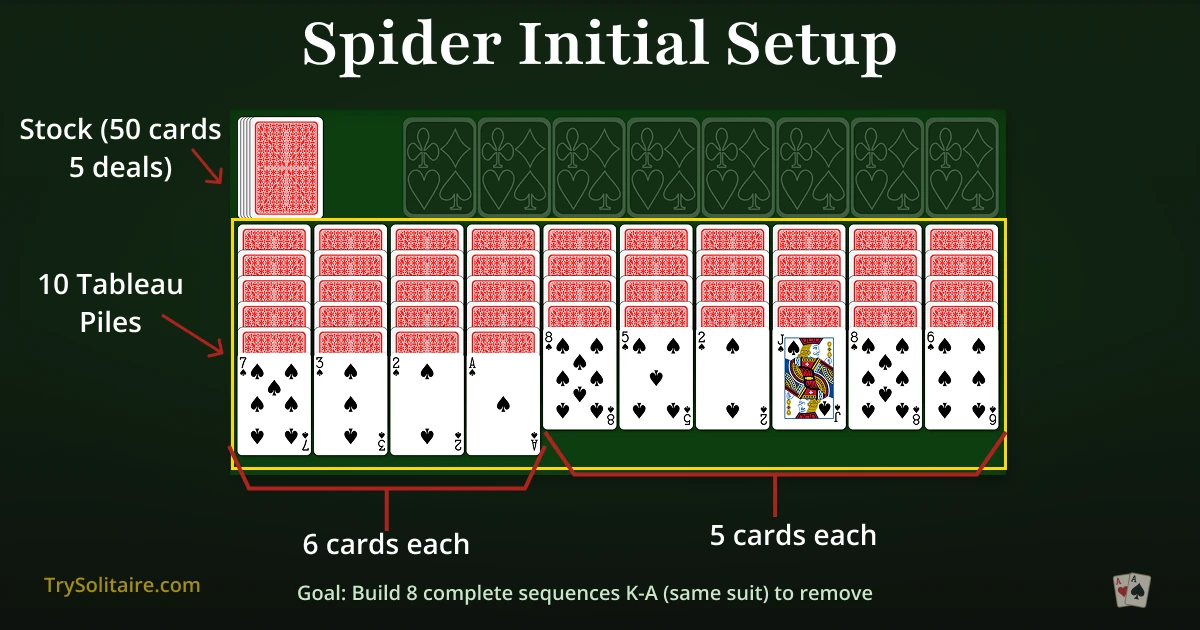
Spider Solitaire begins with a specific deal pattern using 104 cards (two complete decks):
- Tableau: Ten columns are dealt. The first four columns receive 6 cards each, and the remaining six columns receive 5 cards each. Only the top card in each column starts face-up.
- Stock: The remaining 50 cards are kept in the stock pile, divided into 5 groups of 10 cards each.
- No Foundations: Unlike Klondike, Spider has no foundation piles. You build sequences directly in the tableau.
Building Sequences - The Core Mechanics
Spider Solitaire's gameplay revolves around building descending sequences:
- Descending Rank Only: You can place any card on another card of one rank higher, regardless of suit. For example, you can place any 7 on any 8, or any Queen on any King.
- Suit Matters for Moving Groups: While you can build mixed-suit sequences, you can only move a group of cards together if they're in the same suit and in descending order.
- Complete Sequences Clear: When you build a complete 13-card sequence from King down to Ace in the same suit (K-Q-J-10-9-8-7-6-5-4-3-2-A), it automatically removes from the tableau.
- Empty Columns: Any card or valid sequence can be placed in an empty column, making empty spaces incredibly valuable strategic tools.
Stock Pile Rules
When you've exhausted all moves in the tableau, you can deal a new row from the stock:
- Each deal places one card face-up on each of the ten columns
- You must fill all empty columns before you can deal from the stock
- There are five deals available (50 cards ÷ 10 columns = 5 deals)
- Strategic timing of stock deals is crucial - dealing too early can block important moves
The Golden Rule of Spider
Always prioritize in-suit sequences over mixed-suit builds. While mixed-suit sequences are legal, they limit your ability to move cards as groups. Expert players avoid mixing suits whenever possible, as in-suit sequences provide maximum flexibility.
Complete Suit Sequences: How Cards Are Removed
A complete sequence consists of all 13 cards of the same suit arranged in descending order:
All 13 cards must be the same suit (♠ ♥ ♦ ♣)
- Automatic Removal: Once you build a complete King-to-Ace sequence in the same suit, it automatically clears from the tableau with a satisfying animation
- Must Be In-Suit: Mixed-suit sequences do not count - all 13 cards must be the same suit (e.g., all Spades or all Hearts)
- Location Doesn't Matter: The complete sequence can be in any tableau column; it doesn't need to be in a specific position
- Goal: Eight Sequences: You need to complete all eight sequences (104 cards ÷ 13 = 8 sequences) to win the game
Winning & Losing
You win Spider Solitaire when all 104 cards have been cleared from the tableau by completing all eight King-to-Ace sequences. The game is lost when you've dealt all five stock rows and can no longer make any legal moves, leaving incomplete sequences on the board.
Spider Solitaire Difficulty Levels: 1-Suit, 2-Suit & 4-Suit Explained
The genius of Spider Solitaire lies in its three difficulty modes, each offering a dramatically different experience:
1-Suit (Easy)
Suits: Spades only
Best For: Beginners & learning
All 104 cards are Spades, eliminating suit-matching concerns. Focus on pure sequencing strategy.
2-Suit (Medium)
Suits: Spades & Hearts
Best For: Intermediate players
52 Spades and 52 Hearts. Requires careful suit management and planning.
4-Suit (Expert)
Suits: All four suits
Best For: Expert players
The ultimate challenge. Winning requires perfect play and favorable deals.
Difficulty Comparison: Understanding the Suit System
1-Suit (Easy)
Suits Used: ♠ Spades only
Cards: 104 Spades (8 copies of each rank)
Win Rate: 85-90% with skilled play
Every card fits with every other card, making this perfect for learning core Spider mechanics without suit-matching complexity.
2-Suit (Medium)
Suits Used: ♠ ♥ Spades & Hearts
Cards: 52 Spades + 52 Hearts
Win Rate: ~20% with skilled play
The "goldilocks" difficulty - challenging enough to stay engaging but achievable with good strategy. Most popular mode among experienced players.
4-Suit (Expert)
Suits Used: ♠ ♥ ♦ ♣ All four suits
Cards: 26 of each suit
Win Rate: 1-2% even for experts
One of the hardest single-player card games ever created. Requires perfect play, deep planning, and often favorable luck to win.
Progression Tip: Master 1-suit Spider (achieving 70%+ win rate) before attempting 2-suit. Only move to 4-suit after consistent success in 2-suit mode. Rushing to harder difficulties leads to frustration rather than improvement.
1-Suit Spider: The Perfect Starting Point
1-suit Spider uses only Spades, which means every card can potentially fit into any sequence. This removes the suit-matching complexity and lets you focus on learning core Spider strategies:
- No need to worry about suit conflicts when building sequences
- All cards can be moved as groups since everything is in-suit
- Win rate of 85-90% with skilled play makes it extremely satisfying for learners
- Perfect for understanding empty column strategy and timing stock deals
Most players should spend significant time mastering 1-suit before attempting harder modes. Achieving a consistent 70%+ win rate in 1-suit indicates readiness for 2-suit challenges.
2-Suit Spider: The Sweet Spot
2-suit Spider (Spades and Hearts) is considered the "goldilocks" difficulty - not too easy, not impossibly hard. It introduces suit management while remaining achievable:
- 52 Spades and 52 Hearts create meaningful strategic choices
- Mixed-suit builds become necessary, requiring foresight about when to use them
- Win rate around 20% means victories feel earned but not frustratingly rare
- Develops the skill to identify and exploit in-suit building opportunities
Many Spider enthusiasts consider 2-suit the "true" Spider Solitaire experience - challenging enough to remain engaging indefinitely while still being winnable with good play.
4-Suit Spider: The Ultimate Challenge
4-suit Spider is one of the hardest single-player card games ever designed. Using all four suits (Spades, Hearts, Diamonds, Clubs), it demands near-perfect play:
- Finding in-suit building opportunities becomes extremely rare
- Most sequences will be mixed-suit, limiting mobility
- Win rate of only 1-2% means you might play dozens of games between victories
- Requires deep lookahead, perfect empty column management, and often favorable luck
4-suit Spider separates casual players from true masters. Even expert players celebrate 4-suit victories as major achievements. If you're winning even 5% of 4-suit games, you're in the elite tier of Spider players worldwide.
Spider Solitaire 4-Suit Strategy
Winning at 4-suit Spider requires exceptional patience and advanced techniques. Focus on suit isolation - dedicate specific columns to specific suits whenever possible. Accept that you'll need to create mixed-suit builds, but treat them as temporary sacrifices. The key is identifying which face-down cards you absolutely must expose versus which can wait. Plan your stock deals carefully, as each new row can destroy carefully constructed sequences. Most importantly, recognize unwinnable games early - if you have multiple suits deeply mixed with many face-down cards blocking them, it may be unsolvable.
Spider Solitaire 4-Suit Expert Tips
Mastering 4-suit Spider Solitaire represents the pinnacle of solitaire achievement. With only a 1-2% win rate, every victory is hard-earned. These expert tips will help you identify and capitalize on winnable 4-suit games:
4-Suit Opening Strategy
The first 10-15 moves in 4-suit Spider are critical. Scan the initial tableau for in-suit building opportunities before making any moves. Identify which suits appear most frequently in face-up cards - these become your "target suits" for early completion. Create at least one empty column within the first 20 moves if possible, as this flexibility is essential for managing the suit chaos that develops in mid-game.
Advanced Suit Isolation Techniques
In 4-suit play, suit isolation becomes an art form. Designate specific columns for specific suits whenever feasible. For example, if Column 2 has a strong Spades sequence (9-8-7-6 of Spades), avoid placing Hearts, Diamonds, or Clubs there unless absolutely necessary. This "columnar suit segregation" technique dramatically increases your chances of completing sequences by keeping suits separated rather than hopelessly mixed.
When to Accept Mixed-Suit Builds
Unlike 1-suit and 2-suit Spider, 4-suit Spider requires strategic use of mixed-suit builds. Accept mixed builds when: 1) They expose multiple face-down cards, 2) They create empty columns, 3) They prevent suit mixing in other columns, or 4) You have no in-suit alternatives. However, always plan how you'll "unmix" these sequences later - a mixed-suit King-7 build might be necessary now but creates problems later if you can't dismantle it.
Stock Deal Timing in 4-Suit
Stock deal timing becomes exponentially more important in 4-suit Spider. Before each stock deal, ask: "Will these 10 new cards create unsolvable suit conflicts?" If you have deeply mixed columns with many face-down cards, a stock deal might make the game unwinnable. Sometimes it's better to abandon a game before wasting time on a hopeless position.
Recognizing Unwinnable 4-Suit Games
Expert 4-suit players develop intuition for recognizing unwinnable games early. Red flags include: multiple columns with 3+ suits mixed together, multiple suits "trapped" under face-down cards in the same column, or entering the final stock deal with fewer than 2 empty columns available. Learning to abandon hopeless games saves time and reduces frustration.
4-Suit Practice Progression
Don't expect immediate 4-suit success. A realistic progression path: Start by achieving 80%+ win rate in 1-suit Spider, then 25%+ in 2-suit, before attempting 4-suit seriously. Most expert players spent months on 2-suit before their first 4-suit victory. The 1-2% win rate means you might play 50-100 games between wins - this is completely normal even for experts!
Spider Solitaire Strategy: Expert Tips to Win More Games
Spider Solitaire rewards strategic thinking more than any other solitaire variant. Apply these expert strategies to dramatically improve your win rate:
Critical Strategic Principles
- Empty Columns are Gold: Creating and maintaining empty columns is your most powerful tool. Empty spaces let you rearrange sequences, expose face-down cards, and store problematic cards temporarily. In 2-suit and 4-suit, try to maintain at least one empty column at all times.
- Build In-Suit Whenever Possible: Even when you can make a mixed-suit build, look for in-suit alternatives first. In-suit sequences can be moved as units, providing flexibility that mixed sequences lack.
- Uncover Face-Down Cards First: Your top priority should always be revealing hidden cards. More information means better decisions. Favor moves that expose new cards over moves that merely rearrange visible cards.
- Delay Stock Deals: Don't deal from the stock until you've exhausted all tableau moves. Every stock deal adds ten cards to manage, so make sure you've maximized your current position first.
- Think Several Moves Ahead: Before committing to a move, trace out the next 3-5 moves. Will this create useful empty columns? Will it expose face-down cards? Will it lead to a complete sequence?
- Target Completable Sequences Early: Identify columns that are closest to completing a King-to-Ace sequence. Focus your efforts on columns where you have deep in-suit builds with few face-down cards remaining.
Strategic Decision-Making: Key Tactics
Empty Column Creation
Empty columns are your most powerful strategic tool. They allow you to:
- Temporarily store Kings or long sequences
- Rearrange cards to create in-suit builds
- Access face-down cards blocked by mixed sequences
- Pivot between different strategic approaches
Priority Rule: Try to create your first empty column within the first 15-20 moves. In 2-suit and 4-suit, maintain at least one empty column at all times.
In-Suit Building Priority
Building sequences in the same suit provides critical flexibility:
- In-suit sequences move as units: 9♠-8♠-7♠ can be moved together
- Mixed-suit sequences are immobile: 9♠-8♥-7♠ cannot move as a group
- Always check for in-suit options: Even when mixed builds seem easier
- Plan ahead: Consider how each move affects future in-suit opportunities
Expert Technique: When you must make a mixed-suit build, plan how you'll "unmix" it later using empty columns and strategic card placement.
Uncovering Face-Down Cards
Revealing hidden cards should be your top priority:
- Information is power: More visible cards = better decisions
- Target columns strategically: Prioritize columns with fewer face-down cards
- Sacrifice mixed builds if necessary: Exposing cards is often worth temporary inefficiency
- Track face-down counts: Remember which columns have the most hidden cards
Common Mistake: Don't waste moves rearranging visible cards when you could be exposing new cards. New information is almost always more valuable than optimization.
Stock Deal Timing
Knowing when to deal from the stock is critical:
- Exhaust all moves first: Never deal until you have zero valid tableau moves
- Consider the consequences: Will 10 new cards create unsolvable suit tangles?
- Fill empty columns: You must fill all empty columns before dealing
- Strategic positioning: In 4-suit, position your columns to minimize suit mixing from new cards
Advanced Tip: Before your final stock deal, ensure you have a clear path to completing multiple sequences. If not, the game may be unwinnable.
Think Ahead: The 3-5 Move Rule
Before making any move, mentally trace out the next 3-5 moves. Ask yourself:
- Will this create an empty column? (Good!)
- Will this expose face-down cards? (Good!)
- Will this force me to mix suits unnecessarily? (Bad!)
- Will this lead to completing a sequence? (Excellent!)
- Am I blocking future in-suit building opportunities? (Avoid!)
This mental lookahead separates good Spider players from great ones. With practice, you'll develop pattern recognition that makes this analysis instant.
Advanced Techniques for 2-Suit & 4-Suit
Once you've mastered 1-suit, these advanced techniques become essential:
- Suit Isolation Strategy: Try to isolate each suit into specific columns. If you have a strong Spades build in one column, avoid placing Hearts there unless absolutely necessary.
- Sacrifice Builds: Sometimes you must create mixed-suit sequences (knowing they can't move as units) to access critical face-down cards. This is acceptable if it opens better long-term opportunities.
- Stock Deal Timing: In 2-suit and 4-suit, carefully plan stock deals to minimize suit mixing. If possible, position your columns so the new cards land favorably.
- Partial Sequence Recognition: Track partial in-suit sequences (like 9-8-7 of Spades) even if they're not complete. These are building blocks for future complete sequences.
- Endgame Management: In the late game with few stock cards left, calculate whether you have enough moves and empty columns to complete all remaining sequences. If not, the game may be unwinnable.
The "Undo" Learning Strategy
Use the unlimited undo feature aggressively while learning. When you face a difficult decision, try one path, play it out for several moves, then undo and try the alternative. This rapid experimentation helps you develop intuition for what leads to winning positions versus dead ends. Over time, you'll recognize patterns without needing to test every option.
Common Mistakes to Avoid
- Dealing Stock Too Early: The #1 mistake beginners make. Always exhaust tableau moves first.
- Filling Empty Columns Carelessly: Don't waste empty columns on random cards. Use them strategically for Kings or to facilitate important rearrangements.
- Mixing Suits Unnecessarily: Every mixed-suit build reduces flexibility. Only mix when it serves a clear purpose.
- Forgetting Long-Term Planning: Don't just make the "obvious" next move. Think 3-5 moves ahead.
- Giving Up Too Early: Many games that look hopeless have winning lines. Keep searching for creative solutions.
For deeper coverage — the supermove-style group rules, why empty columns matter so much, and the strategies that move you from 1-suit to 4-suit — see the Spider Solitaire strategy guide.
Why Play Spider Solitaire on TrySolitaire?
TrySolitaire offers the best Spider Solitaire experience available online, with features that enhance both learning and enjoyment:
✓ All Three Difficulty Modes
All three Spider modes sit on one page. Switch between 1-suit, 2-suit, and 4-suit from the difficulty selector without reloading.
✓ Unlimited Undo/Redo
Experiment fearlessly with unlimited undo. Test different strategies, learn from mistakes, and find optimal solutions without penalty.
✓ 100% Free to Play
No "premium" features locked behind paywalls. Just pure Spider Solitaire exactly as it should be.
✓ Comprehensive Statistics
Track your progress across all three difficulty modes with detailed stats: games played, games won, win percentage, best time, current streak, and longest streak. Watch your skills improve over time.
✓ Works Completely Offline
Our Progressive Web App (PWA) technology means Spider Solitaire works flawlessly without internet. Perfect for flights, commutes, or anywhere without reliable WiFi.
✓ Mobile-Optimized
Touch-optimized interface works beautifully on phones and tablets. Drag cards smoothly, tap to auto-move, and enjoy responsive design that adapts to any screen size.
✓ Multiple Card Themes
Customize your experience with 4 different card styles and 9 card back designs. Find the visual style that's easiest on your eyes.
✓ Hint System
Stuck? The hint system suggests valid moves, helping you learn optimal play patterns. Great for beginners developing their Spider skills.
✓ Sound Effects (Optional)
Satisfying audio feedback for moves, completed sequences, and victories. Easily toggle sounds on/off based on your preference.
✓ No Sign-Up Required
Start playing immediately - no email, no account creation, no personal information. Your statistics save locally in your browser.
▶ Play Spider Solitaire Free NowFrequently Asked Questions About Spider Solitaire
Related Solitaire Games & Resources
If you enjoy Spider Solitaire, explore our complete solitaire games collection with many strategic variants. Also compare Spider vs FreeCell to see which strategic game suits your style best, or try Klondike for the classic solitaire experience.
Complete Spider Solitaire Learning Path
Master Spider Solitaire with our comprehensive resource library. Whether you're a complete beginner or expert player seeking advanced techniques, we have guides for every skill level.
📚 Strategy & Rules
- Complete Spider Solitaire Guide — rules, supermove math, the strategies, history
- Strategies That Actually Work — empty columns, suit management, stock-deal timing
- Common Spider Mistakes — what to avoid mid-game
🎓 Difficulty & Win Rates
- Spider Solitaire 4 Suits — the hard version, 25–35% skilled win rate, the classic Microsoft Spider difficulty
- Spider Solitaire 2 Suits — intermediate, 60–70% skilled win rate, the sweet spot for most players
- Spider Win Rates by Suit Count — 1-suit, 2-suit, 4-suit data and what skill level can expect
- Spider vs Klondike — when each is the right pick
- Hardest Solitaire Games — where 4-suit Spider sits among the toughest variants
More Solitaire Learning Resources
- Complete Guide to Solitaire Games
- How to Play Solitaire (All Variants)
- Complete Guide to Solitaire Variants
- Best Solitaire Games Ranked
- Hardest Solitaire Games (Spider 4-Suit Ranked #1)
- Universal Solitaire Strategy Principles
- The Fascinating History of Solitaire
- Solitaire Terms & Glossary
Ready to Master Spider Solitaire?
Whether you're looking for the satisfying wins of 1-suit mode, the balanced challenge of 2-suit, or the ultimate test of 4-suit Spider, TrySolitaire offers the perfect platform to develop your skills. Start with 1-suit, master the strategies, and work your way up to becoming a Spider Solitaire expert.
▶ Play Free Spider Solitaire Now