Spider Solitaire 2 Suits — Free Online, Intermediate Mode
Two-suit Spider is the middle setting: spades and hearts only across the same ten tableau columns and the same five-deal stock as the four-suit version. The reduced suit count brings skilled win rates up to roughly 20–40% (versus 5–15% in 4-suit), while still rewarding the same-suit-run discipline that makes Spider what it is. Most experienced players use 2-suit as their default — challenging enough to plan, finish-able often enough to stay engaging. New: a Winnable (2 Suits) dropdown option guarantees a solvable deal from a pool of seeds verified by real winners. Free in your browser, no sign-up.
Quick Start: Play in 30 Seconds
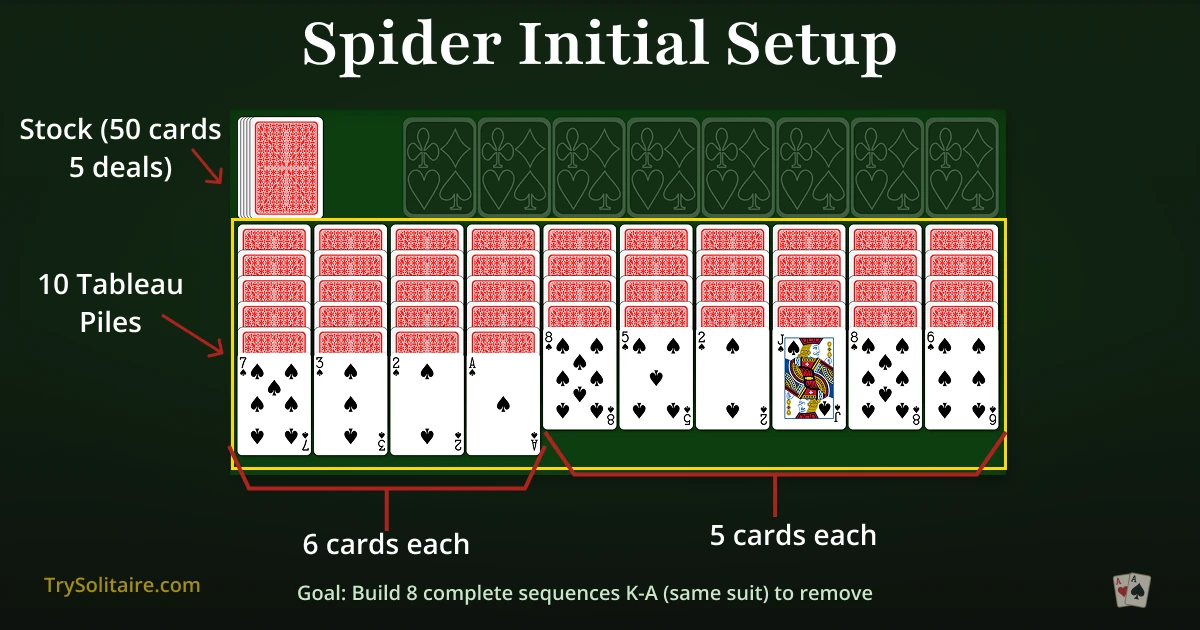
- Goal: Build eight complete King-to-Ace sequences in the same suit. Four spades runs and four hearts runs.
- Build down on the tableau: any descending move is legal regardless of suit (a hearts 9 lands on a spades 10). Only same-suit descending runs move as a group.
- Empty columns: any card or valid descending sequence can fill them.
- Stock: Click to deal one card to every column. Five deals total. You can't deal if any column is empty — fill empty columns first.
- Win condition: all eight foundations filled — game complete.
Click Play Spider 2 Suits and you're playing. Drag or tap. Unlimited undo means you can experiment without restarting.
Why 2-Suit Spider Sits in the Middle
The three Spider difficulty levels are a step function. Most of the difficulty between 1-suit and 4-suit comes from one rule: multi-card moves require all cards to be the same suit.
| Mode | Suits in play | Accidental same-suit chance | Skilled win rate |
|---|---|---|---|
| 1 Suit | 1 (spades) | Automatic — every move is same-suit | ~85–90% |
| 2 Suits | 2 (spades + hearts) | ~50% | ~20–40% |
| 4 Suits | All four | ~25% | ~5–15% |
In 2-suit Spider, roughly half of the descending sequences you build will land on the same suit by accident, because there are only two suits to choose from. That changes the game's rhythm: instead of carefully protecting rare same-suit fragments (4-suit) or grouping every descending sequence freely (1-suit), you make ordinary moves and expect that about half of them will work out for the auto-lift. The game still rewards planning, but the planning horizon is shorter.
Winnable Mode — Skip the Unsolvable Deals
The new-game dropdown now has a Winnable (2 Suits) option alongside the usual 2 Suits button. Picking it shuffles from a pool of seeds we already know solve to a clear, so the deal you face is guaranteed to have a path home — no wasted hour on a position that was lost from the first deal.
- Where the seeds come from: the same yearly table that powers the daily-deal rotation, drawn from real wins by players on TrySolitaire. Every entry in the table has been solved end-to-end at least once.
- Random vs. winnable: the plain 2 Suits button shuffles freely — most deals are solvable but a minority are not. The Winnable (2 Suits) button always returns a seed from the verified pool.
- Skill still required: "winnable" means a solution exists, not that the solution is obvious. You can still lose by making the wrong moves; the unlimited undo button is there for when you do.
- Daily Challenge is already winnable: if you've been playing the Daily (2 Suits) challenge, you've been on the verified pool all along — winnable mode just lets you draw fresh seeds from it whenever you want, without waiting for tomorrow.
Direct link: play a winnable 2-suit deal.
What's the Best 2-Suit Spider Strategy?
Three tactical points specific to playing two suits. The general Spider strategy (protect same-suit fragments, don't deal from the stock unless forced, Aces aren't urgent) carries over from 4-suit Spider.
Track which suit is leading
With two suits in play, you'll almost always be further along on one. Lean into it. Finishing one full Kings-to-Ace spades run frees up specific cards for the next spades run, which is a much faster path than alternating attention between suits.
Trade across suits when one of them is stuck
If your spades sequence is locked behind a wall of hearts, sometimes the right move is to break the spades fragment and rebuild around the hearts you can actually move. Same-suit fragments aren't sacred when they're trapped.
Save empty columns for same-suit transfers
An empty column is most valuable when you have a same-suit sequence that needs temporary storage to swap cards above it. Don't dump a random card into an empty column just to clear it — wait for a move that actually uses the storage.
How Often Can You Win 2-Suit Spider?
Spider has no peer-reviewed solvability study like Yan, Diaconis, Rusmevichientong and Van Roy (2005) for Klondike, so exact theoretical figures are unknown. The numbers generally accepted in published solver-assisted play data:
- Skilled players, 2-suit: ~20–40% practical win rate.
- Average players, 2-suit: ~10–20%.
- For reference, 1-suit: ~85–90% skilled. 4-suit: ~5–15% skilled.
If you find 4-suit too frustrating to enjoy and 1-suit too easy to feel earned, 2-suit is the version most players settle on long-term. Wins are common enough that a session reliably reaches a clear, rare enough that they still feel like skill rather than luck.
The Three Spider Difficulty Levels
The same engine runs all three. Switch from the new-game menu.
- Spider Solitaire — 1 Suit — the easy version. All spades. Practically every deal is winnable with patience. Useful for learning the rhythm of Spider before adding suit constraints. Available via the difficulty menu on the main Spider page.
- Spider Solitaire — 4 Suits — the hard version. All four suits in play, skilled win rates ~5–15%. The classic Microsoft Spider difficulty.
- Spider Solitaire — All Modes — the difficulty-selector hub if you're not sure which to start with.
Frequently Asked Questions
Is Spider Solitaire 2 Suits free to play?
Yes. Spider Solitaire 2 Suits on TrySolitaire is free, with no download or sign-up. The game runs in your browser and can be installed as an app on any device, after which it works without an internet connection.
Which two suits are used in 2-suit Spider?
Spades and hearts in our version — one black suit and one red suit, giving you four full decks worth of cards (52 spades plus 52 hearts) distributed across the ten columns. The suit choice is conventional rather than strict; the difficulty is the same regardless of which two suits are picked.
How hard is 2-suit Spider compared to 1-suit and 4-suit?
Right in the middle. 1-suit Spider has practical win rates around 85–90% for skilled players because every sequence you build moves as a group. 4-suit drops that to 5–15% because multi-card moves require all cards to be the same suit. 2-suit lands at roughly 20–40% skilled — you have to plan suit-by-suit but the constraint isn't quite as punishing as four-suit.
What's the goal in 2-suit Spider?
Build eight complete King-to-Ace sequences, each in the same suit. Four of the eight will be spades and four will be hearts. When a same-suit King-to-Ace sequence is complete, it auto-lifts off the board to a foundation. Clearing all eight wins the game.
Can you move multi-card sequences in 2-suit Spider?
Yes, but only if the sequence is same-suit and descending. A spades 9-8-7 moves as a group; a spades 9 with a hearts 8 does not. The reduced suit count compared to 4-suit means you'll assemble same-suit sequences more often by accident — half your descending runs will land on the right suit.
Is 2-suit a good warm-up for 4-suit Spider?
Yes. 2-suit teaches the same-suit-run discipline that makes 4-suit playable, but with twice the chance of an accidental same-suit fragment. Most experienced players warm up with a 2-suit game before committing 30 to 40 minutes to a 4-suit session.
What does the "Winnable (2 Suits)" option do?
It deals you a shuffle picked from a pool of seeds verified to be solvable. The regular 2 Suits button shuffles freely — most deals are winnable, but some aren't. The winnable button only draws from seeds that real players have already taken to a clear. You still have to find the moves yourself, so a deal can be lost by playing badly, but it can't be lost because the deal was unsolvable from the start.
Ready to Play?
Free, in your browser, no sign-up. Two suits, ten columns, eight foundations. The Spider difficulty that finds the sweet spot.
Play Spider 2 Suits Free Play a Winnable Deal